 English
 Deutsch
 Español
 Italiano
 Français
 Português do Brasil
 Tiếng Việt
 ไทย
 Bahasa Indonesia
 Русский
 العربية
 हिन्दी

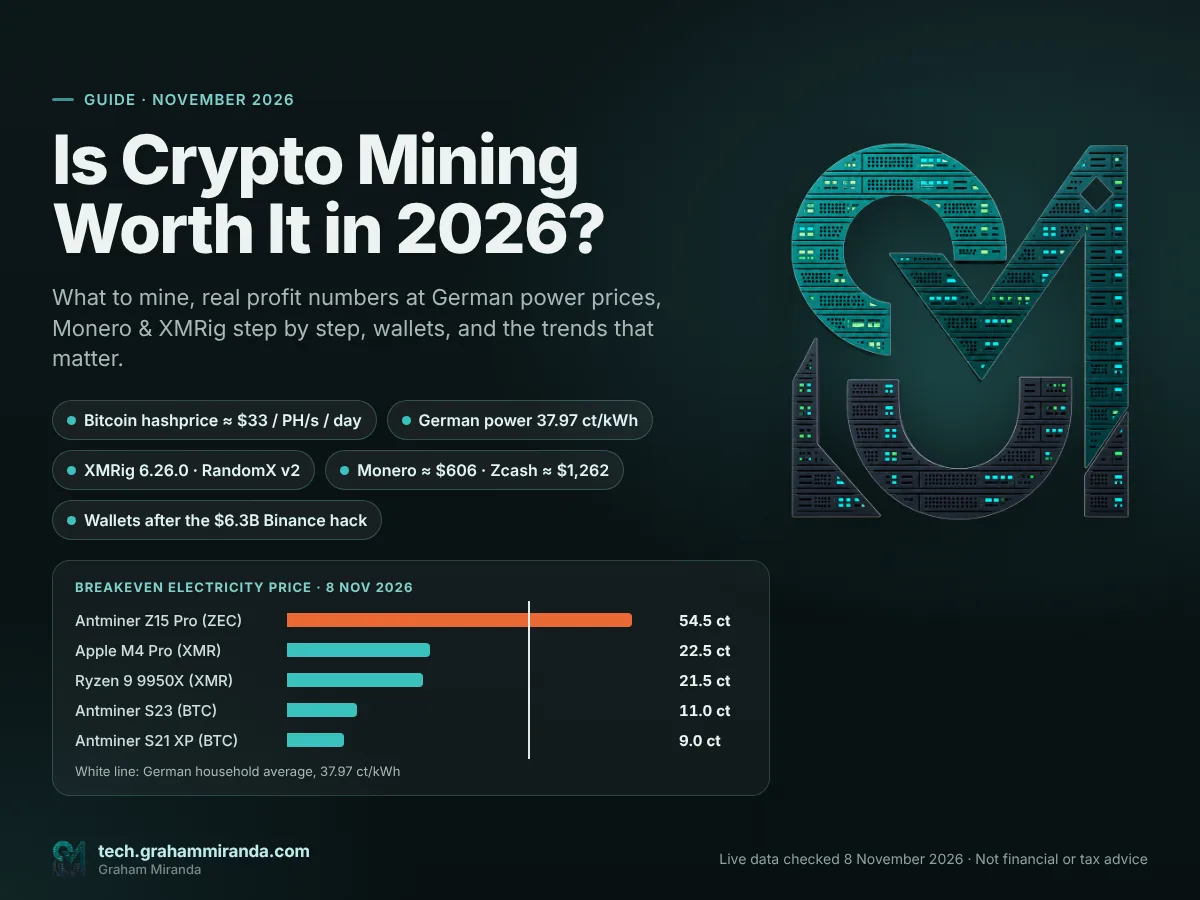
Is crypto mining worth it in 2026? For most people reading this in Germany, the honest answer is no. For a few of you, it’s a surprising yes. Both answers come down to one number on your electricity bill, and this guide shows you exactly where that line sits for every kind of hardware, from a gaming PC to a 3.5-kilowatt Bitcoin miner.
Mining in late 2026 is a strange business. Bitcoin’s network sits close to its all-time high at just over one zettahash, a billion trillion guesses every second. Yet the money each machine earns is close to the lowest it has ever been. The largest listed Bitcoin miners are quietly turning their warehouses into AI data centres. Monero nearly touched $800 in January and now finds itself fending off ASICs, outsiders and EU regulators at the same time. Zcash went from $184 to more than $1,200 this year and turned a three-year-old ASIC into one of the most profitable machines you can plug in. And on 29 October, the world’s largest exchange lost $6.3 billion to North Korean hackers, which is the best argument for owning a proper wallet I’ve seen in years.
This is the long answer. It covers what mining actually pays today, what to mine in 2026 with the hardware you already own, how to mine Monero with XMRig step by step, where your coins should land once you’ve mined them, and the trends that will decide whether any of this still makes sense when Bitcoin halves again in 2028.
Every figure below was checked against live data, official documentation, release notes and price pages on 8 November 2026, and the profit maths was run in code rather than estimated. Mining numbers move daily: coin prices, network hashrate and difficulty all shift under your feet, and a calculator that says “profit” on Monday can say “loss” on Friday. Volatile numbers are dated where they appear. Check them before you buy anything.
Disclosure: This article contains no affiliate links and no sponsored content. It isn’t financial, investment or tax advice; I’m not a financial adviser or a Steuerberater. My company, Graham Miranda UG (haftungsbeschränkt), provides hosting and IT services and earns nothing from any hardware, pool, wallet or coin mentioned here. Mining software such as XMRig is legal, open-source software, but only run it on hardware you own and on electricity you pay for. No company mentioned here has reviewed or approved this article.
TL;DR — Crypto Mining in 2026 in Ten Bullets
- At German household power prices, almost nothing pays. The average household contract costs about 37.97 ct/kWh. The best air-cooled Bitcoin ASIC breaks even at about 11 ct, a top gaming CPU mining Monero at about 21.5 ct, an Apple M4 Pro at about 22.5 ct.
- One exception: Zcash. An Antminer Z15 Pro (Equihash) breaks even at about 54.5 ct/kWh at today’s ZEC price of roughly $1,262, so it’s in profit even at German retail rates, on paper. It stops being profitable if ZEC falls below about $880, and ZEC traded at $184 earlier this year.
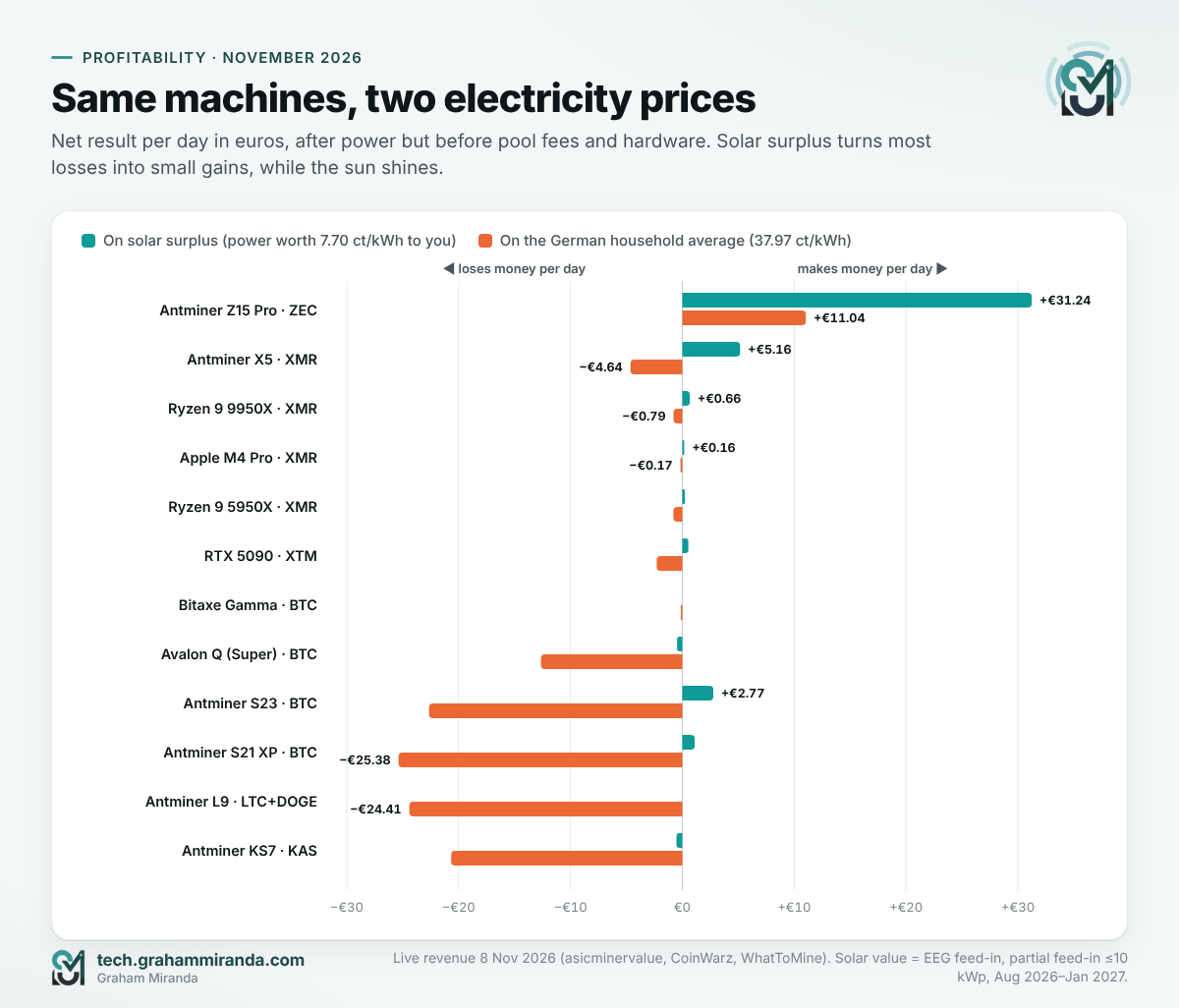
- Solar changes the maths. Power you’d otherwise export is worth only the feed-in tariff you give up: 7.70 ct/kWh for small systems until January 2027. At that price, most efficient hardware is in the black, but only while the sun shines.
- Bitcoin mining at home is a lottery or a heater, not a business. Hashprice is about $33 per PH/s per day, near June’s record low of $27.74, and fees are just 0.66% of block rewards. A $150-ish Bitaxe has roughly a 1-in-16,600 chance per year of finding a block worth about $238,000.
- Monero is still the coin for ordinary computers. XMRig 6.26.0 (March 2026) gets about 28 kH/s from a tuned Ryzen 9 9950X, worth roughly €1 a day before power. Mine through P2Pool to keep the network decentralised, and update before the FCMP++ and RandomX v2 upgrade, which developers are loosely targeting for Q2 2027.
- GPU mining is essentially over. The best liquid coin earns an RTX 5090 about $1.40 a day. Renting the same card to AI customers can gross several times that.
- Mine to your own wallet, never an exchange. Binance lost $6.3 billion in a hack on 29 October and shuts its mining pool and cloud mining on 10 November. Kraken caps Monero withdrawals at $1,500 a month for individuals, and from 10 July 2027 EU-regulated platforms may no longer handle privacy coins at all.
- Hardware wallets had a rough year. A Coldcard firmware flaw produced weak seeds, and implanted Ledger devices were sold through a third-party reseller. Buy direct from the maker, keep firmware current, and consider multisig across two brands.
- The trends that matter: Bitcoin miners becoming AI landlords (TeraWulf alone has $12.8 billion in AI contracts), a 1 ZH/s network, a home-mining revival, a privacy-coin boom and squeeze, a cancelled Monero ASIC, proof-of-useful-work coins, Germany’s new DAC8 reporting since January 2026, and the next halving around April 2028.
- Tax in Germany: mining rewards are taxable income when you receive them (commercial income or, for hobby miners, § 22 Nr. 3 EStG with a €256 threshold), and selling the coins within a year falls under § 23 EStG (€1,000 threshold). Keep records from day one.
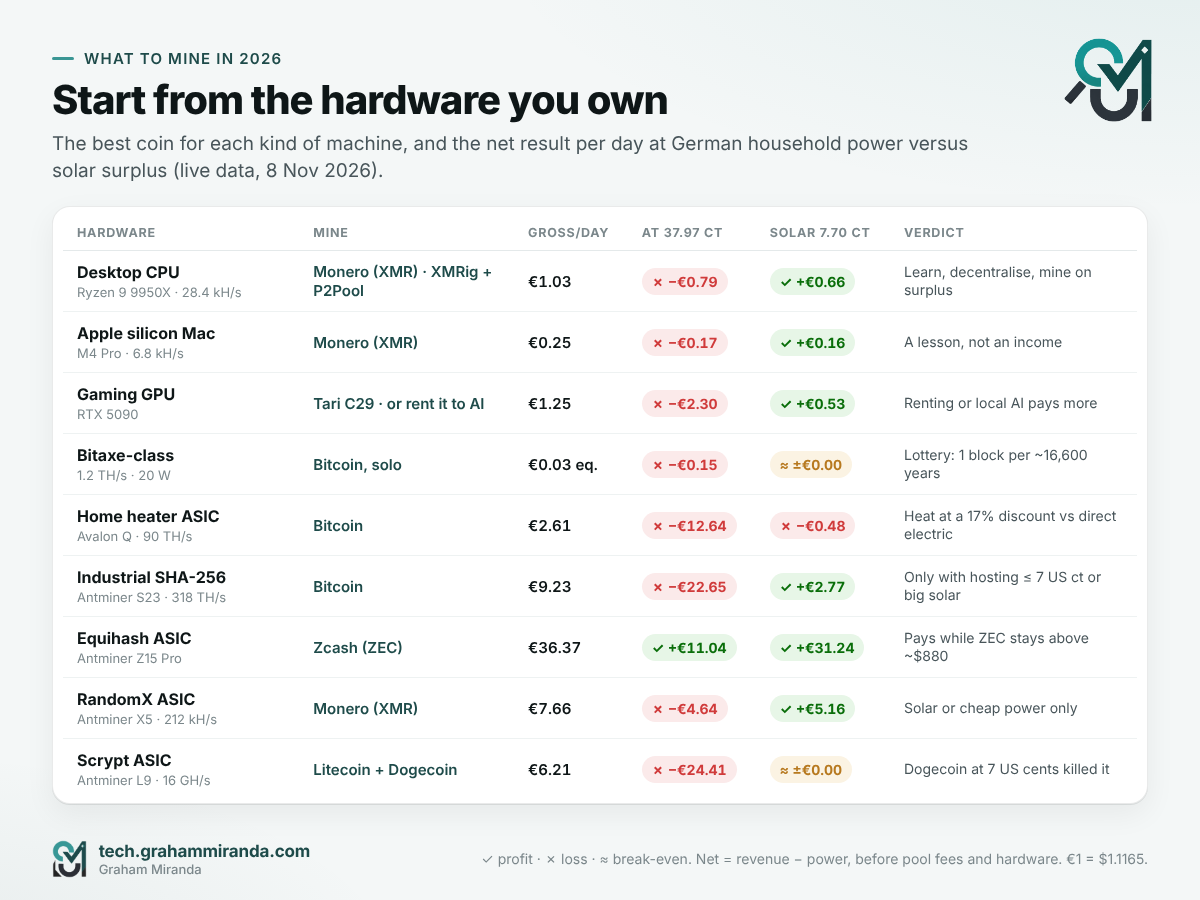
The 2026 Mining Scorecard at a Glance
| Hardware you have | Best thing to mine (Nov 2026) | Gross per day | At German household power (37.97 ct) | On solar surplus (7.70 ct) |
|---|---|---|---|---|
| Gaming or workstation CPU (Ryzen 9 9950X) | Monero (XMR) with XMRig, ideally via P2Pool | €1.03 | ❌ −€0.79 a day | ✅ +€0.66 a day |
| Apple silicon Mac (M4 Pro) | Monero (XMR) | €0.25 | ❌ −€0.17 a day | ✅ +€0.16 a day |
| Gaming GPU (RTX 5090) | Tari’s GPU lane (C29), or better: rent it to AI | €1.25 | ❌ −€2.30 a day | ⚠️ +€0.53 a day; renting pays more |
| Bitaxe-class solo miner (1.2 TH/s) | Bitcoin, solo | €0.03 equivalent | ❌ It’s a lottery ticket | ⚠️ Still a lottery ticket |
| Home “heater” miner (Avalon Q) | Bitcoin | €2.61 | ❌ −€12.64 a day | ⚠️ Roughly break-even |
| Industrial Bitcoin ASIC (Antminer S23) | Bitcoin | €9.23 | ❌ −€22.65 a day | ✅ +€2.77 a day, if you have 3.5 kW of surplus |
| Equihash ASIC (Antminer Z15 Pro) | Zcash (ZEC) | €36.37 | ✅ +€11.04 a day, if ZEC holds above ~$880 | ✅ +€31.24 a day |
| RandomX ASIC (Antminer X5) | Monero (XMR) | €7.66 | ❌ −€4.64 a day | ✅ +€5.16 a day |
| Scrypt ASIC (Antminer L9) | Litecoin + Dogecoin | €6.21 | ❌ −€24.41 a day | ⚠️ Break-even |
Gross revenue before pool fees and hardware costs, from live data on 8 November 2026. Full method and all fourteen machines in Part 2.
Table of Contents
- Part 1 — How Crypto Mining Works in 2026: The Five-Minute Version
- Part 2 — Is Crypto Mining Worth It in 2026? The Real Numbers
- Part 3 — What to Mine in 2026: Coin by Coin
- Part 4 — How to Mine Monero With XMRig: The Step-by-Step Guide
- Part 5 — Crypto Wallets for Miners: Where Your Coins Should Land
- Part 6 — Crypto Mining Trends 2026: What’s Actually Changing
- Part 7 — Crypto Mining in Germany: Tax, Power and Paperwork
- Part 8 — Twelve Mistakes New Miners Make
- Part 9 — Should You Mine? Seven Scenarios
- Frequently Asked Questions
- The Bottom Line
Part 1 — How Crypto Mining Works in 2026: The Five-Minute Version
You can skip this part if you already know what a hashrate is. If you don’t, five minutes here will save you money later, because almost every bad mining decision comes from misunderstanding one of the four ideas below.
Proof of work in one paragraph
Coins such as Bitcoin, Monero and Zcash are secured by proof of work. Miners collect waiting transactions into a block, then race to find a random number that makes the block’s fingerprint (its hash) fall below a target. There’s no shortcut: finding that number takes trillions of guesses, while checking it takes one. The winner adds the block to the chain and collects the block reward, made up of newly created coins (the subsidy) plus the transaction fees. Bitcoin pays a subsidy of 3.125 BTC per block since the April 2024 halving; Monero pays a permanent 0.6 XMR per block, its “tail emission”.
Difficulty: why more miners doesn’t mean more money
Every network adjusts its difficulty so blocks keep arriving at a steady pace however much hardware joins. Bitcoin retargets every 2,016 blocks (about two weeks) to keep blocks ten minutes apart; Monero adjusts every block for a two-minute target. The consequence is brutal and simple: the total reward is fixed, so every new machine on the network shrinks everyone else’s slice. Bitcoin’s hashrate rose from about 853 EH/s in June 2026 to roughly 1,050 EH/s in early November, about a quarter more competition in five months, and that alone cut each machine’s earnings by a fifth even before price moved.
Pools and shares: why solo mining is a lottery
If you mine solo, you either find a whole block or you get nothing. With a home machine, “nothing” is overwhelmingly likely. A pool combines thousands of miners and splits each block it finds. It measures your contribution with shares, easier solutions that prove you were working, and pays you in proportion, minus a fee that usually sits between 0% and 2%. Pools turn a lottery into a salary. A small salary.
Hashprice: the one number a miner actually needs
Hashprice is what one unit of hashing power earns per day. For Bitcoin it’s quoted in dollars per petahash per second per day ($/PH/s/day). On 1 November 2026 it stood at $33.18, down 17.5% in a month and not far off June’s all-time low of $27.74. One PH/s is 1,000 TH/s, so each terahash of Bitcoin mining power earns about 3.3 US cents a day. Everything else in Bitcoin mining economics follows from that number and your electricity price.
The profit formula, and the only formula you need before buying hardware
Daily revenue  = (your hashrate ÷ network hashrate) × coins issued per day × coin price × (1 − pool fee)
Daily profit   = daily revenue − (power in kW × 24 h × your price per kWh)
Breakeven price per kWh = daily revenue ÷ (power in kW × 24)
Run the last line before you spend a cent. An Antminer S21 XP (270 TH/s, 3,645 W) grossed $8.75 on 8 November. It burns 87.5 kWh a day. $8.75 ÷ 87.5 kWh = 10.0 US cents per kWh, or about 9.0 euro cents. Pay more than that and the machine loses money every hour it runs, before you’ve paid for the machine itself. For Bitcoin there’s a handy shortcut at today’s hashprice: breakeven in US cents per kWh ≈ 138 ÷ the machine’s efficiency in J/TH.
The algorithm map
Each proof-of-work coin uses its own puzzle, its algorithm, and that decides which hardware wins.
| Algorithm | Main coins | Hardware that wins | Status in November 2026 |
|---|---|---|---|
| SHA-256 | Bitcoin (BTC), Bitcoin Cash | ASICs only (Antminer S23 family, S21 XP, Bitaxe) | Network above 1 ZH/s, hashprice near record lows |
| Equihash | Zcash (ZEC) | ASICs (Antminer Z15 family) | The most profitable ASIC class this autumn, on ZEC’s rally |
| RandomX | Monero (XMR), Tari, Salvium, Zephyr | CPUs; Bitmain’s X5 ASIC exists, the X9 was reportedly cancelled | RandomX v2 coming with Monero’s FCMP++ upgrade |
| Scrypt | Litecoin (LTC) and Dogecoin (DOGE), merge-mined | ASICs (Antminer L9) | Dogecoin near 7 US cents; margins gone |
| kHeavyHash | Kaspa (KAS) | ASICs (Antminer KS7) | KAS near 3 US cents; unprofitable at home |
| Cuckaroo29 (C29) | Tari’s GPU lane (XTM) | GPUs | The best liquid GPU option, and it’s thin |
| NoisyGEMM (matrix multiplication) | Pearl (PRL) | NVIDIA GPUs | New “proof-of-useful-work” coin since April 2026, thinly traded |
Part 2 — Is Crypto Mining Worth It in 2026? The Real Numbers
Here’s the honest version: is crypto mining worth it in 2026 depends less on which coin you pick than on what you pay for a kilowatt-hour. Crypto mining profitability comes down to one subtraction, revenue minus power, so let’s put real numbers on both.
The market on 8 November 2026
| Metric | Value | Why it matters |
|---|---|---|
| Bitcoin price | About $76,000, roughly 40% below its high of about $126,000 on 6 October 2025; 2026 low $59,005 on 30 June | Revenue is paid in BTC, your bills in euros |
| Bitcoin network hashrate | About 1,050 EH/s (7-day average), record 1,156 EH/s in October 2025 | The size of the crowd you’re splitting rewards with |
| Bitcoin difficulty | 148.36 T since 29 October; record 155.97 T (October 2025) | Next adjustment due around 13 November; most early estimates point slightly lower |
| Hashprice | About $33 per PH/s per day; record low $27.74 (6 June 2026) | Revenue per machine |
| Fees as a share of rewards | 0.66% (October 2026) | Bitcoin miners live almost entirely on the subsidy, which halves around April 2028 |
| Monero (XMR) | About $606; record close to $798 in mid-January 2026 | The coin most home miners actually mine |
| Monero network | About 6.5–6.9 GH/s; record 7.54 GH/s on 16 January 2026 | About 432 new XMR are issued per day |
| Zcash (ZEC) | About $1,262, after a 2026 low of $184 | Why Equihash ASICs suddenly pay |
| Litecoin / Dogecoin | About $51.85 / $0.071 | Dogecoin has lost about two-thirds since April |
| Euro | $1.1165 per euro (6 November) | Used for every conversion below |
The German electricity problem
Germany has some of the most expensive household electricity in the world, and mining is nothing but electricity converted into coins.
| Tariff (November 2026) | Price per kWh |
|---|---|
| Average household contract (all contracts, first half of 2026) | 37.97 ct |
| Cheapest tariff for new customers | 33.32 ct |
| Default supply (Grundversorgung) | 40.39 ct |
| Solar feed-in tariff you give up by using your own surplus (partial feed-in, up to 10 kWp, Aug 2026–Jan 2027) | 7.70 ct |
| What large hosted miners pay (reference) | about 7 US cents (≈ 6.3 ct) |
In other words, a German household pays about six times what a large hosted Bitcoin miner pays for the same kilowatt-hour. No amount of clever coin-picking closes a six-fold cost gap. What can close it is changing which kilowatt-hours you use, and we’ll get to that.
Fourteen machines, one spreadsheet
I ran every common class of mining hardware through the same maths, using live revenue data from 8 November 2026 and the German tariffs above.
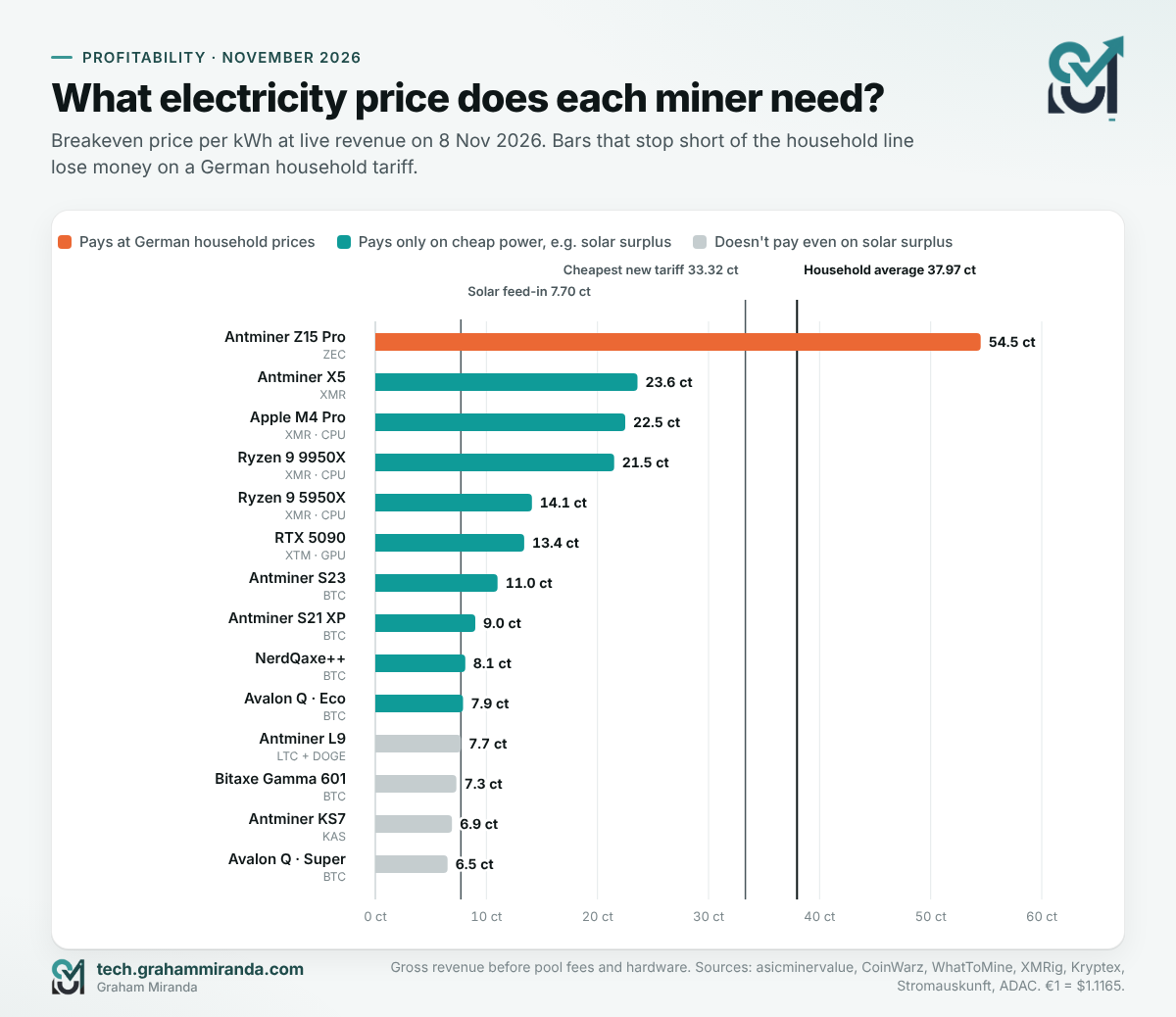
| Machine | Mines | Hashrate | Power | Gross/day | Power cost/day at 37.97 ct | Net/day at 37.97 ct | Net/day on solar surplus (7.70 ct) | Breakeven |
|---|---|---|---|---|---|---|---|---|
| Antminer S23 (air) | BTC | 318 TH/s | 3,498 W | $10.31 (€9.23) | €31.88 | −€22.65 | +€2.77 | 11.0 ct/kWh |
| Antminer S21 XP | BTC | 270 TH/s | 3,645 W | $8.75 (€7.84) | €33.22 | −€25.38 | +€1.10 | 9.0 ct/kWh |
| Avalon Q (Super mode) | BTC | 90 TH/s | 1,674 W | $2.92 (€2.61) | €15.25 | −€12.64 | −€0.48 | 6.5 ct/kWh |
| Avalon Q (Eco mode) | BTC | 54 TH/s | 830 W | $1.75 (€1.57) | €7.56 | −€6.00 | +€0.03 | 7.9 ct/kWh |
| NerdQaxe++ | BTC | 4.8 TH/s | 72 W | $0.16 (€0.14) | €0.66 | −€0.52 | +€0.01 | 8.1 ct/kWh |
| Bitaxe Gamma 601 | BTC | 1.2 TH/s | 20 W | $0.04 (€0.03) | €0.18 | −€0.15 | ±€0.00 | 7.3 ct/kWh |
| Antminer Z15 Pro | ZEC | 840 kSol/s | 2,780 W | $40.61 (€36.37) | €25.33 | +€11.04 | +€31.24 | 54.5 ct/kWh |
| Antminer X5 | XMR | 212 kH/s | 1,350 W | $8.55 (€7.66) | €12.30 | −€4.64 | +€5.16 | 23.6 ct/kWh |
| Ryzen 9 9950X (XMRig 6.26, tuned) | XMR | 28.4 kH/s | 200 W | $1.15 (€1.03) | €1.82 | −€0.79 | +€0.66 | 21.5 ct/kWh |
| Ryzen 9 5950X (older desktop) | XMR | 13 kH/s | 140 W | $0.53 (€0.47) | €1.28 | −€0.80 | +€0.21 | 14.1 ct/kWh |
| Apple M4 Pro | XMR | 6.82 kH/s | 46 W | $0.28 (€0.25) | €0.42 | −€0.17 | +€0.16 | 22.5 ct/kWh |
| RTX 5090 (best liquid coin) | XTM (C29) | 28.5 G/s | 390 W | $1.40 (€1.25) | €3.55 | −€2.30 | +€0.53 | 13.4 ct/kWh |
| Antminer L9 (16 GH/s) | LTC + DOGE | 16 GH/s | 3,360 W | $6.93 (€6.21) | €30.62 | −€24.41 | ±€0.00 | 7.7 ct/kWh |
| Antminer KS7 | KAS | 36 TH/s | 2,772 W | $5.13 (€4.59) | €25.26 | −€20.67 | −€0.53 | 6.9 ct/kWh |
How these numbers were made. Gross revenue is before pool fees (0–2%) and before paying for the hardware. ASIC rows use asicminervalue’s live revenue figures for 8 November 2026 (Bitcoin rows other than the S21 XP are scaled from it, which implies a hashprice of $32.41/PH/s/day). CPU rows use Monero’s 432 XMR per day, a 6.45 GH/s network estimate and $605.87 per XMR from CoinWarz on the same day. The KS7 is my estimate from Kaspa’s network figures; the RTX 5090 uses WhatToMine’s most profitable coin. CPU power figures are the processor’s measured draw, so a whole PC uses more. €1 = $1.1165. Every source is listed at the end of the article.
What the table is really telling you
1. Nothing that mines Bitcoin pays at German household prices. The best air-cooled machine on sale, the Antminer S23 at 11 J/TH, needs electricity under about 11 cents. To break even at 37.97 ct, Bitcoin would have to trade at roughly $262,000 (S23) or $321,000 (S21 XP), with difficulty frozen where it is. It won’t be frozen.
2. Ordinary computers are closer than you’d think. A tuned Ryzen 9 9950X needs power under about 21.5 ct and an Apple M4 Pro under about 22.5 ct. That’s still far below what you pay, but it’s within reach of solar surplus, cheap dynamic-tariff hours and heat you were going to buy anyway. Monero would have to reach roughly $1,000–1,070, above January’s record, for these two to break even at the German average.
3. Zcash is the outlier. At about $1,262 per ZEC, an Antminer Z15 Pro earns more than it burns even at 37.97 ct, about €11 a day net. The catch is in the small print: the machine lists at $7,190–13,400 before import VAT, it screams at 75 dB, it pulls 2.8 kW all day, and it falls into the red if ZEC drops below about $880. At today’s numbers, the hardware alone takes roughly two to three and a half years to pay back. Zcash traded at $184 in 2026.
4. Dogecoin’s slide wrecked Scrypt. In April a Litecoin–Dogecoin miner grossed about one and a half times as much from Dogecoin as from Litecoin. With DOGE down to about 7 cents, an L9 now needs power under 7.7 ct.
5. Small doesn’t mean efficient, and efficient doesn’t mean profitable. A Bitaxe (about 16.7 J/TH) is actually less efficient than an S21 XP (13.5 J/TH), and an Avalon Q at 18.6 J/TH is less efficient again. You’re paying for silence and convenience, not better economics.
Where mining can make sense in Germany
If the household tariff kills the business case, the trick is to mine with kilowatt-hours that aren’t worth 38 cents to you. There are four ways that works.
1. Solar surplus. If you have a PV system, a kilowatt-hour you use instead of exporting costs you only the feed-in tariff you give up: 7.70 ct for partial feed-in systems up to 10 kWp commissioned between August 2026 and January 2027 (older systems have their own, often higher, rates; check yours). At that price a 9950X makes about €0.66 a day, an Antminer X5 about €5.16 and an S23 about €2.77. Two catches. Solar produces in daylight, and a 3.5 kW ASIC needs 3.5 kW of surplus all day, which you’ll rarely have outside summer; small loads such as a CPU, a Bitaxe or a NerdQaxe fit real solar curves far better. And newer systems fall under the Solarspitzengesetz (in force since 25 February 2025): they receive no feed-in payment at all during negative-price hours, of which Germany had almost 575 in 2025. In those hours, surplus power is worth literally nothing to you, and a miner is a perfectly rational way to use it.
2. Dynamic tariffs. Since 2025, every German electricity supplier has had to offer a dynamic tariff, with prices that change by the hour, to customers with a smart meter. Mining only when the price is very low or negative can work for a small, automatable load. It’s fiddly, it needs a smart meter, and the earnings are small, but it’s honest money if you already live on a dynamic tariff.
3. Heat you’d pay for anyway. A miner turns every watt into heat, exactly like a fan heater. If you heat a room with direct electric heating, an Avalon Q in Super mode delivers about 40 kWh of heat a day and earns €2.61 doing it, so your heat effectively costs about 31.5 ct/kWh instead of 37.97 ct: a 17% discount. That’s the whole “bitcoin heater” story. It falls apart next to a heat pump, which delivers three to four kilowatt-hours of heat per kilowatt-hour of electricity, so heat-pump heat costs roughly 11 ct/kWh. A miner is a good electric heater and a bad heat pump.
4. Hosting abroad. Plenty of companies will run your ASIC in a data centre with cheap power for around 6–8 US cents per kWh. At 7 cents, an S21 XP nets about $2.63 a day and an S23 about $4.43. That’s real, but you’re now investing in someone else’s operation: hosting contracts, minimum terms, shipping, customs, repairs you can’t see, and the counterparty risk of a company that holds your hardware. Read the contract like a loan agreement.
The costs nobody puts in the calculator
Mining calculators show revenue minus electricity. Your bank account sees more:
- Hardware depreciation. ASICs lose value fast. Each new generation (the S23 family has been shipping since January 2026) makes the last one less valuable, and the 2028 halving will cut every Bitcoin machine’s revenue in half overnight.
- Import VAT and customs. Most ASICs ship from Hong Kong or mainland China. Budget 19% import VAT plus shipping on top of the listed price.
- Pool fees. 0% on P2Pool, typically 0.6–1% elsewhere for Monero, and up to a few percent on some Bitcoin pools.
- Wiring and safety. A 3.5 kW machine needs a dedicated circuit, not a Schuko extension lead (Part 7).
- Noise and heat. Industrial ASICs run at 75 dB or more. In summer you may pay again to cool the room.
- Difficulty growth. Revenue per machine falls whenever the network grows, even if the price is flat.
- Your time and your taxes. Part 7 covers the paperwork. It’s not nothing.
The “just buy it” test
Here’s the question that ends most home-mining projects: if you want the coin anyway, would you be better off simply buying it? A 9950X mining Monero at 37.97 ct spends €1.82 on power to earn €1.03 of XMR. That’s paying €1.77 for every euro of Monero, before the wear on your PC. If all you want is to own XMR or BTC, buying is cheaper.
There are honest reasons to mine anyway: you’re learning how these networks work, you’re using power that’s worth almost nothing to you, you want to strengthen a network you care about, or you want coins that come straight from the network rather than from an exchange account. Those are good reasons. “Passive income” isn’t one of them at German household prices.
Part 3 — What to Mine in 2026: Coin by Coin
The right question isn’t “which coin should I mine?” It’s “what can the hardware I own mine profitably, at the power price I actually pay?” Start from the hardware.
Bitcoin (SHA-256): the biggest network, the thinnest margins
Bitcoin mining in 2026 is an industrial business run by companies paying 4–7 US cents per kWh, with fleets of hydro-cooled machines and hedged power contracts. The newest Bitmain generation shows how far efficiency has come:
| Machine | Hashrate | Power | Efficiency | Cooling |
|---|---|---|---|---|
| Antminer S23 | 318 TH/s | 3,498 W | 11.0 J/TH | Air |
| Antminer S23 Hyd | 580 TH/s | 5,510 W | 9.5 J/TH | Water |
| Antminer S23e Hyd 2U | 865 TH/s | 8,650 W | 10.0 J/TH | Water, rack-mounted |
| Antminer S23 Hyd 3U | 1,160 TH/s | 11,020 W | 9.5 J/TH | Water, rack-mounted |
| Antminer S21 XP (2024) | 270 TH/s | 3,645 W | 13.5 J/TH | Air |
Market prices on 2 November ranged from about $1,755 for an S21 (200 TH/s) and $4,200 for an S21 XP to $16,300 for an S23 XP Hyd. Even the best of these needs electricity well below 15 US cents to make sense, and the network’s average cash cost of producing one bitcoin sat around $75,500 in the second quarter of 2026, according to CoinShares’ estimate. With bitcoin at about $76,000, the average miner is barely covering cash costs. The inefficient ones aren’t.
Two Bitcoin-specific things to know in November 2026:
- Binance Pool shuts down on 10 November 2026 at 07:00 UTC, together with Binance’s cloud-mining product. Shares submitted after that aren’t credited, and payout records disappear on 24 November. If your machines point at Binance, move them now.
- Pool concentration is high. In recent blocks, AntPool, Foundry USA and F2Pool together found close to two-thirds of all blocks. If decentralisation matters to you, look at pools that let miners build their own block templates (OCEAN’s DATUM protocol, Stratum V2 pools) or at solo mining.
Verdict: At German household prices, mining Bitcoin at home doesn’t pay. With hosting at 6–7 US cents or genuine solar surplus, efficient machines turn a modest profit until the 2028 halving.
The solo lottery: can a Bitaxe really find a block?
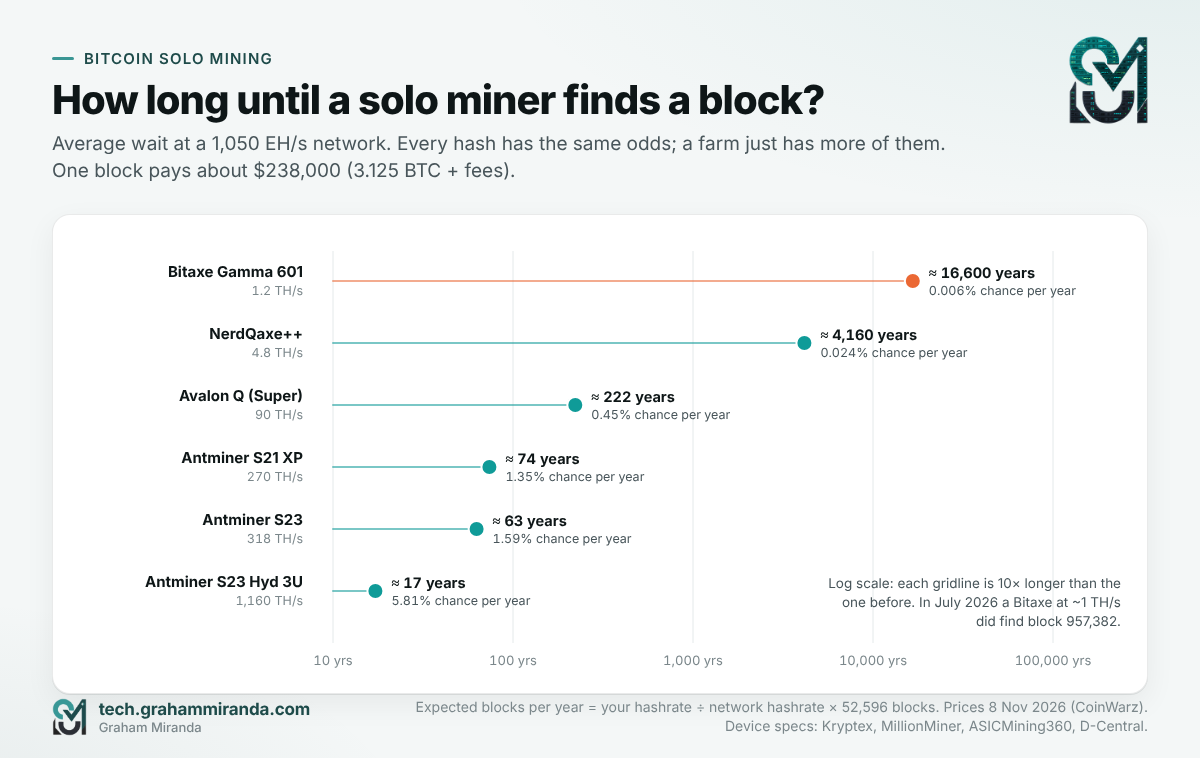
Yes, and it keeps happening. In July 2026 a hobbyist’s Bitaxe, averaging about 995 GH/s on Public Pool, found block 957,382 and won 3.1382 BTC, about $200,000 at the time. CoinDesk counted 12 solo blocks in 2026 by mid-July and 24 over the preceding twelve months, including one found on 31 May by a miner running fourteen small Canaan Nano units.
The maths is simple, and it’s the same for everyone: your chance of finding the next block equals your share of the network’s hashrate. At 1,050 EH/s:
| Device | Hashrate | Chance of a block per year | On average, one block every… |
|---|---|---|---|
| Bitaxe Gamma 601 | 1.2 TH/s | 0.006% | ~16,600 years |
| NerdQaxe++ | 4.8 TH/s | 0.024% | ~4,160 years |
| Avalon Q (Super) | 90 TH/s | 0.45% | ~222 years |
| Antminer S21 XP | 270 TH/s | 1.35% | ~74 years |
| Antminer S23 | 318 TH/s | 1.59% | ~63 years |
| Antminer S23 Hyd 3U | 1,160 TH/s | 5.8% | ~17 years |
A Bitaxe costs about €0.18 a day in German power, around €67 a year, for a 0.006% annual chance at a block worth about $238,000 (3.125 BTC plus fees at today’s price). The expected value, about $14 a year, is better than most lotteries, which is to say you’ll almost certainly spend the €67 and have fun doing it. That’s a perfectly fine way to spend €67. Just don’t call it an investment.
Zcash (Equihash): the surprise of 2026
Zcash had a year nobody predicted. After running about 809% in 2025, it fell as low as $184 in 2026, then rallied to more than $1,200 by September as demand for shielded (private) transactions grew. It traded around $1,262 on 8 November.
Two days earlier, on 6 November, Zcash activated its NU7 network upgrade. It cuts the target block time from 75 seconds to 25 seconds, shuts down Sprout, Zcash’s original privacy pool, and recycles 60% of transaction fees: instead of going straight to miners, that share is removed from circulation and paid back to miners gradually, starting around 2031. For miners that’s a small cut in fee income today, while the block subsidy stays the main source of revenue.
Zcash has been ASIC-only since 2018, and the dominant machine is Bitmain’s Antminer Z15 Pro: 840 kSol/s at 2,780 W, 75 dB, released in June 2023. On 8 November it grossed about $40.61 a day. At German household prices that’s a profit of about €11 a day; on solar surplus, about €31.
The risks are big, though:
- Price. The Z15 Pro breaks even at 37.97 ct only while ZEC stays above about $880. Zcash’s 2026 low was $184.
- Hardware cost. Listings ranged from $7,190 to $13,400 before tax on 8 November, inflated by the rally. Add 19% import VAT.
- Concentration. Reported figures put Foundry’s pool at roughly 30% of Zcash’s hashrate.
- Protocol direction. The Zcash community has discussed moving towards a hybrid proof-of-stake design for years. Nothing of the sort was in NU7, but it’s a structural risk for any hardware with a multi-year payback.
Verdict: The only ASIC category that clears German retail prices today, on paper. Treat it as a leveraged bet on ZEC’s price, made with noisy hardware you’ll need a garage and a dedicated circuit for.
Monero (RandomX): the people’s coin, with an asterisk
Monero is the coin built for ordinary computers. Its RandomX algorithm runs random programs that lean on a CPU’s cache, memory and branch prediction, which makes general-purpose processors competitive and specialised chips hard to build. It also pays a permanent 0.6 XMR per two-minute block forever, about 432 XMR a day, so miners never depend on fees alone.
What one machine earns at today’s figures (432 XMR a day, a 6.45 GH/s network, $605.87 per XMR):
| Hardware | Hashrate | XMR per day | Gross per month | Power per month at 37.97 ct |
|---|---|---|---|---|
| Ryzen 9 9950X (tuned, XMRig 6.26) | ~28.4 kH/s | ~0.0019 XMR (about 1 XMR every 17 months) | ~€31 | ~€55 |
| Apple M4 Pro | ~6.8 kH/s | ~0.00046 XMR (about 1 XMR every 6 years) | ~€7.60 | ~€12.80 |
Monero’s 2026 has been eventful. The price peaked close to $798 in mid-January, fell back to the low $300s by February, and has recovered to around $606, about 70% higher than a year ago. The network’s hashrate set a record of 7.54 GH/s on 16 January and sat at about 6.5–6.9 GH/s in early November. Mining is concentrated: on 26 October, SupportXMR (26.3%), Nanopool (17.3%) and Kryptex (16.4%) held about 60% of the hashrate between them, while the decentralised P2Pool had 6.6%.
ASICs are the asterisk. Bitmain’s Antminer X5 (212 kH/s at 1,350 W) has existed since 2023. In December 2025 Bitmain announced the Antminer X9: 1 MH/s at 2,472 W for about $5,600, with shipping planned for July 2026. On paper it would have earned about $39.62 a day, profitable even at German household prices. Within four days the X9 was being discussed on Monero’s GitHub. By mid-May, resellers were refunding pre-orders and reporting that Bitmain had discontinued the machine. As of October, no units had shipped and Bitmain hadn’t made a public statement, although some listings still show the X9. Meanwhile Monero’s developers have prepared RandomX v2 (more on that in Part 4), which is planned to arrive with the next network upgrade.
Verdict: The best coin to mine with a computer you already own, especially through P2Pool and on cheap or free power. It won’t pay a German household electricity bill on a normal PC.
Tari: free coins you may struggle to sell
Tari (XTM) launched its mainnet on 6 May 2025 with four mining “lanes”, each paid 25% of the rewards: RandomX merge-mined with Monero, standalone RandomX, SHA3x for ASICs and Cuckaroo29 (C29) for GPUs. The merge-mining lane is the interesting one: Monero miners can earn Tari at the same time with no extra load, for example through P2Pool’s --merge-mine option.
The problem is the market. On 8 November, XTM traded at about $0.0011, its market capitalisation was around $8 million, and daily trading volume was roughly $17,000 across a handful of small exchanges, led by MEXC. Mining Tari is easy. Turning meaningful amounts of it into euros isn’t.
Verdict: Turn on merge mining if you run P2Pool and a Tari node anyway. Don’t buy anything for it.
Litecoin and Dogecoin (Scrypt)
Litecoin and Dogecoin have been merge-mined since 2014: a Scrypt ASIC mines both at once. An Antminer L9 (16 GH/s, 3,360 W) grossed about $6.93 a day on 8 November, at Litecoin ≈ $51.85 and Dogecoin ≈ $0.071. Its breakeven is about 7.7 ct per kWh. It’s also loud (around 75–80 dB under load) and needs two dedicated circuits. Verdict: No, unless your power is nearly free and your neighbours are far away.
Kaspa
Kaspa’s 10-blocks-per-second blockDAG was a GPU darling in 2022–2023, then ASICs took over completely. With KAS around $0.029, far from its high of about $0.21, my estimate puts an Antminer KS7 (36 TH/s, 2,772 W) at roughly $5.13 a day gross, a breakeven near 6.9 ct. Verdict: No.
GPUs: mining is mostly over, renting isn’t
GPU mining never recovered after Ethereum switched to proof of stake in 2022. On WhatToMine in November 2026, the most profitable liquid coin for an RTX 5090 was Tari’s C29 lane, at about $1.40 a day gross. At German prices, that’s a loss of about €2.30 a day.
The exceptions are new coins:
- Pearl (PRL) launched on 27 April 2026 with a “proof-of-useful-work” design: miners perform large matrix multiplications, the core operation of AI, on NVIDIA GPUs. It hit about $1.65 on 29 May. Hashrate Index noted that one tracker’s RTX 5090 estimate fell from about $33.80 to $17.19 a day within weeks of launch, and in October MinerCompare still showed around $10 a day profit at 10 US cents per kWh. But PRL trades only on minor venues with thin liquidity, and the top “PRL” result on major price sites is a different coin.
- Quantus, a newer coin with post-quantum signatures, also ranks well on paper, with the same thin-market problem.
Paper profits on illiquid coins are not euros. If you have a high-end NVIDIA card, AI customers are the more reliable buyers of its time:
| Option for an RTX 5090 | Gross per day | Notes |
|---|---|---|
| Mining the best liquid coin | ~$1.40 | WhatToMine, November 2026 |
| Renting it out on Vast.ai | ~$5.76–11.52 at 80% utilisation | Vast.ai says hosts earn about $0.30–0.60 per GPU-hour for an RTX 5090; renters paid $0.53–1.19 per hour on 7 November |
| Using it for local AI | — | Often the most valuable use of all |
Renting has its own costs: German power for a 450 W card at 80% utilisation is about €3.28 a day, your PC is tied up while it’s rented, uptime matters, and rental income is taxable. At the low end, renting nets about $2 a day after power; at the high end, about $8. Still better than mining.
Verdict: Don’t buy a GPU to mine. If you own one, renting it or using it for local AI work beats mining in almost every case.
My shortlist by hardware
| You own… | What I’d do in November 2026 |
|---|---|
| A modern desktop CPU | Try Monero with XMRig and P2Pool mini, on solar surplus or cheap hours. Don’t run it 24/7 on household power |
| An Apple silicon Mac | Try XMRig for learning. It’s efficient (about 148 H per watt), but a laptop isn’t built for 24/7 full load |
| A gaming GPU | Rent it out or use it for local AI. Mine only if the power is free |
| A Bitaxe or NerdQaxe | Solo-mine Bitcoin for fun. Budget it as a hobby |
| Solar panels with a summer surplus | A small RandomX or SHA-256 load on automation; a Z15 Pro if you have the space and the risk appetite |
| Cheap industrial power or hosting under 7 US cents | Efficient SHA-256 or Equihash ASICs, with a payback plan that survives the 2028 halving |
| Nothing yet | Don’t start by buying hardware. Run the breakeven formula first |
Part 4 — How to Mine Monero With XMRig: The Step-by-Step Guide
XMRig is the miner almost every Monero miner uses: free, open-source software (GPL-3.0) that runs on Windows, Linux, macOS and FreeBSD, on x86 and ARM processors, and mines RandomX on CPUs. It also supports other algorithms, and GPUs through its OpenCL and CUDA backends. The current version is XMRig 6.26.0, released on 28 March 2026. It added support for RandomX v2, AVX-512 vector AES (VAES-512) for AMD’s Zen 5 processors and RISC-V vector code, and fixed RandomX on ARM64.
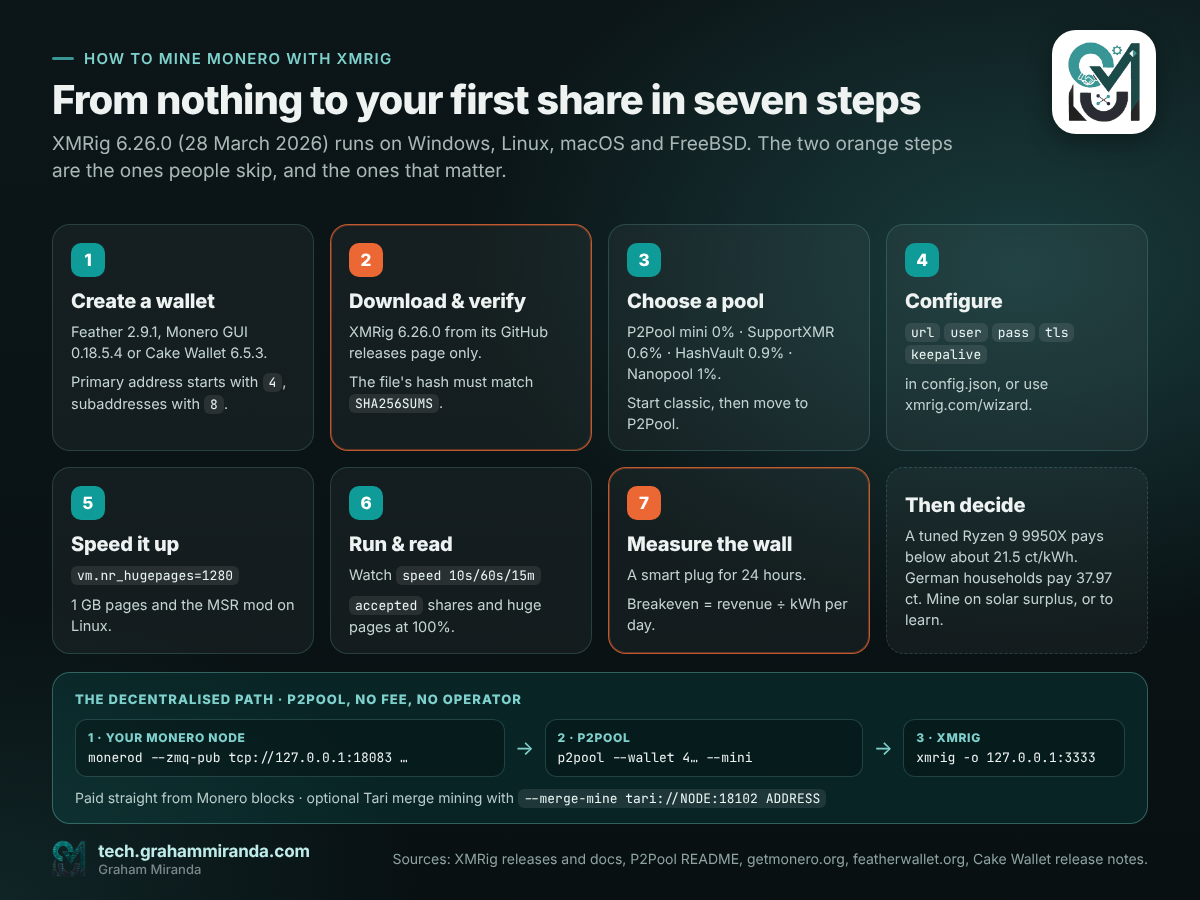
This part walks you through a complete XMRig setup, from nothing to your first payout, in seven steps.
Before you start: four rules
- Only mine on hardware you own, on electricity you pay for. Not your employer’s PCs, not a university lab, not a rented VPS (almost every hosting provider’s terms forbid mining, and cloud CPUs make it a guaranteed loss anyway). Unauthorised mining on someone else’s machine is “cryptojacking”, and it’s illegal.
- Download XMRig only from its official GitHub releases page, and verify the checksum. XMRig is the most common payload in cryptojacking malware, so fake “optimised XMRig” builds on YouTube and Telegram are a classic trap.
- Expect your antivirus to complain. Security tools flag miners as potentially unwanted software because criminals use them. That’s not proof a file is safe or unsafe; your checksum is.
- Don’t mine on a laptop for weeks. Laptops aren’t cooled for 24/7 full load. Desktops, mini PCs and servers are.
Step 1 — Create a Monero wallet
You need an address to be paid to. Create a fresh wallet just for mining:
- Feather Wallet 2.9.1 (2 November 2026) for Windows, macOS 14+ and Linux: light and fast, with Tor support. featherwallet.org
- Monero GUI 0.18.5.4 (16 October 2026), the official wallet, if you’ll run your own node for P2Pool. getmonero.org/downloads
- Cake Wallet 6.5.3 (November 2026) on your phone. cakewallet.com
Write the seed phrase on paper, never in a cloud note. Monero wallets show a primary address that starts with 4 and can generate subaddresses that start with 8. Most pools accept either; P2Pool wants the primary address (Step 8 explains). Part 5 covers wallets properly.
Step 2 — Download XMRig and verify it
Go to the XMRig 6.26.0 release page and download the archive for your system, plus the SHA256SUMS file:
| System | File |
|---|---|
| Windows (Intel/AMD) | xmrig-6.26.0-windows-x64.zip (or -windows-gcc-x64.zip) |
| Windows on ARM | xmrig-6.26.0-windows-arm64.zip |
| Linux, any distribution | xmrig-6.26.0-linux-static-x64.tar.gz |
| Ubuntu 20.04 / 22.04 / 24.04 | -focal-x64, -jammy-x64, -noble-x64 |
| macOS, Apple silicon | xmrig-6.26.0-macos-arm64.tar.gz |
| macOS, Intel | xmrig-6.26.0-macos-x64.tar.gz |
| FreeBSD | xmrig-6.26.0-freebsd-static-x64.tar.gz |
Then check the file against the published checksum before you run anything:
# Linux
sha256sum xmrig-6.26.0-linux-static-x64.tar.gz
# macOS
shasum -a 256 xmrig-6.26.0-macos-arm64.tar.gz
# Windows (PowerShell)
Get-FileHash .\xmrig-6.26.0-windows-x64.zip -Algorithm SHA256
The hash must match the line for your file in SHA256SUMS exactly. The release also carries a GPG signature (SHA256SUMS.sig) if you want to verify the checksum file itself. Then unpack:
tar -xzf xmrig-6.26.0-linux-static-x64.tar.gz && cd xmrig-6.26.0On Windows, extract the zip to a folder such as C:\xmrig. If Microsoft Defender quarantines xmrig.exe, you can add an exclusion for that folder only, and only for a copy you downloaded from the official release and verified yourself. On macOS, Gatekeeper blocks unsigned binaries; remove the quarantine flag with xattr -d com.apple.quarantine ./xmrig after you’ve verified the download.
Step 3 — Choose a pool
You have two kinds of choice: a classic pool run by an operator, or P2Pool, a decentralised pool with no operator at all.
| Pool | Fee | Model | Good for |
|---|---|---|---|
| P2Pool (mini or nano) | 0% | Decentralised; payouts straight from Monero blocks | Anyone willing to run a Monero node; the best choice for the network |
| SupportXMR | 0.6% | Classic pool, the largest | Simple, established |
| HashVault | 0.9% | Classic pool | Low minimum payouts |
| Nanopool | 1% | Classic pool | Beginner-friendly dashboards |
| MoneroOcean | Check site | Algorithm-switching pool | Mining whichever RandomX-family coin pays best, paid in XMR |
Fees from the pools’ published terms as summarised in March 2026; minimum payouts vary by pool and change. Check each pool’s “Getting started” page for current hosts, ports and TLS ports.
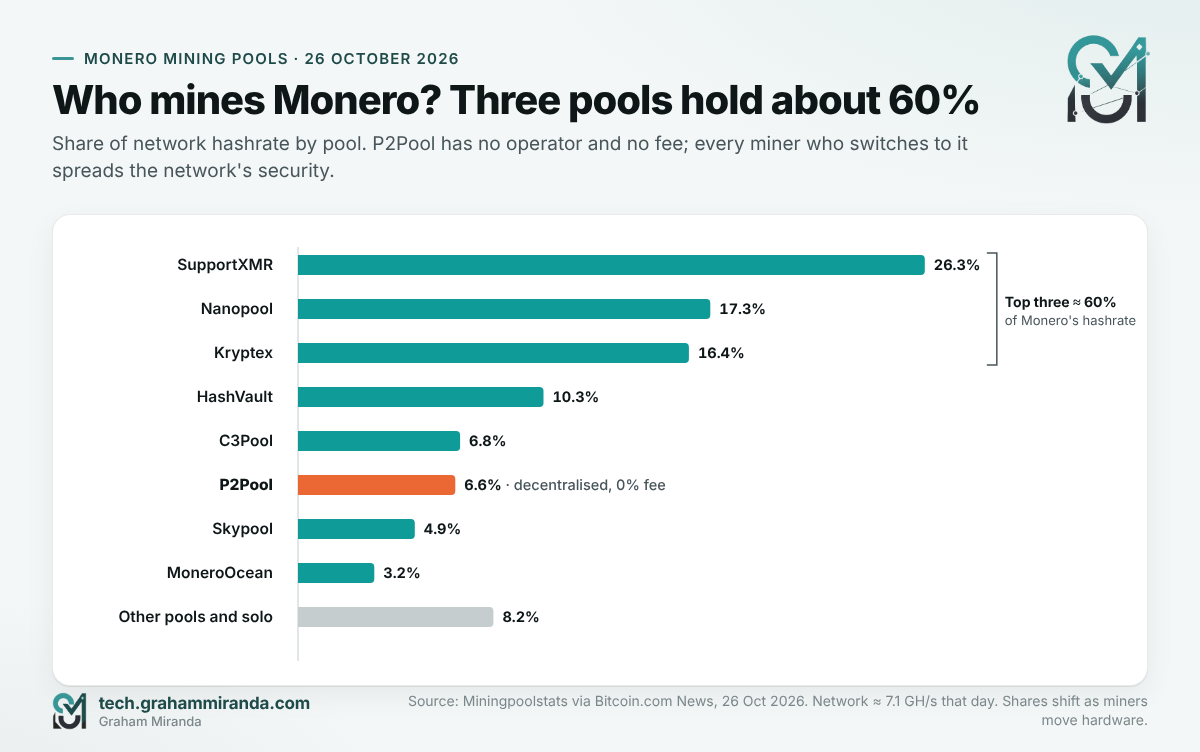
My recommendation: start on a classic pool for a day to see that everything works, then move to P2Pool mini (Step 8). Centralised pools are convenient, but a pool operator with a quarter of the network is exactly the kind of concentration that made Monero vulnerable in 2025.
Step 4 — Configure XMRig
XMRig reads config.json from its own folder. The XMRig configuration wizard builds one for you, or start from this minimal version and replace the placeholders:
{
    "autosave": true,
    "donate-level": 1,
    "cpu": {
        "enabled": true,
        "huge-pages": true,
        "huge-pages-jit": false,
        "max-threads-hint": 100,
        "priority": null,
        "yield": true
    },
    "randomx": {
        "mode": "auto",
        "1gb-pages": false,
        "rdmsr": true,
        "wrmsr": true
    },
    "pools": [
        {
            "url": "pool.supportxmr.com:3333",
            "user": "YOUR_MONERO_ADDRESS",
            "pass": "rig1",
            "keepalive": true,
            "tls": false
        }
    ],
    "http": {
        "enabled": true,
        "host": "127.0.0.1",
        "port": 18888,
        "access-token": "REPLACE-WITH-A-LONG-RANDOM-STRING",
        "restricted": true
    },
    "pause-on-battery": true
}
What each part does:
urlis the pool’s host and port. Copy them from your pool’s “Getting started” page. If the pool offers a TLS port, use it and settlstotrueso your connection is encrypted.useris your Monero address.passis used by many pools as the worker name, which helps you tell several machines apart on the dashboard.keepalivestops idle connections from being dropped.huge-pagesis on by default and matters a lot (Step 5).max-threads-hintcaps how much of the CPU XMRig uses. Set 50–75 if you want to use the machine while it mines;yieldlets other programs take priority.rdmsr/wrmsrenable the MSR tweak when XMRig has the rights to apply it (Step 5).donate-levelis the share of time XMRig mines for its developers: 1%, or one minute in every hundred. The official builds don’t go lower without recompiling. It’s a fair price for software this good; leave it.httpturns on XMRig’s read-only API on your own machine, protected by a token, so you can monitor it without opening anything to the network. Never bind it to0.0.0.0without a firewall.pause-on-batterystops mining when a laptop unplugs.
Everything you don’t set falls back to XMRig’s defaults. The same setup as a one-liner, if you prefer the command line:
./xmrig -o pool.supportxmr.com:3333 -u YOUR_MONERO_ADDRESS -p rig1 -k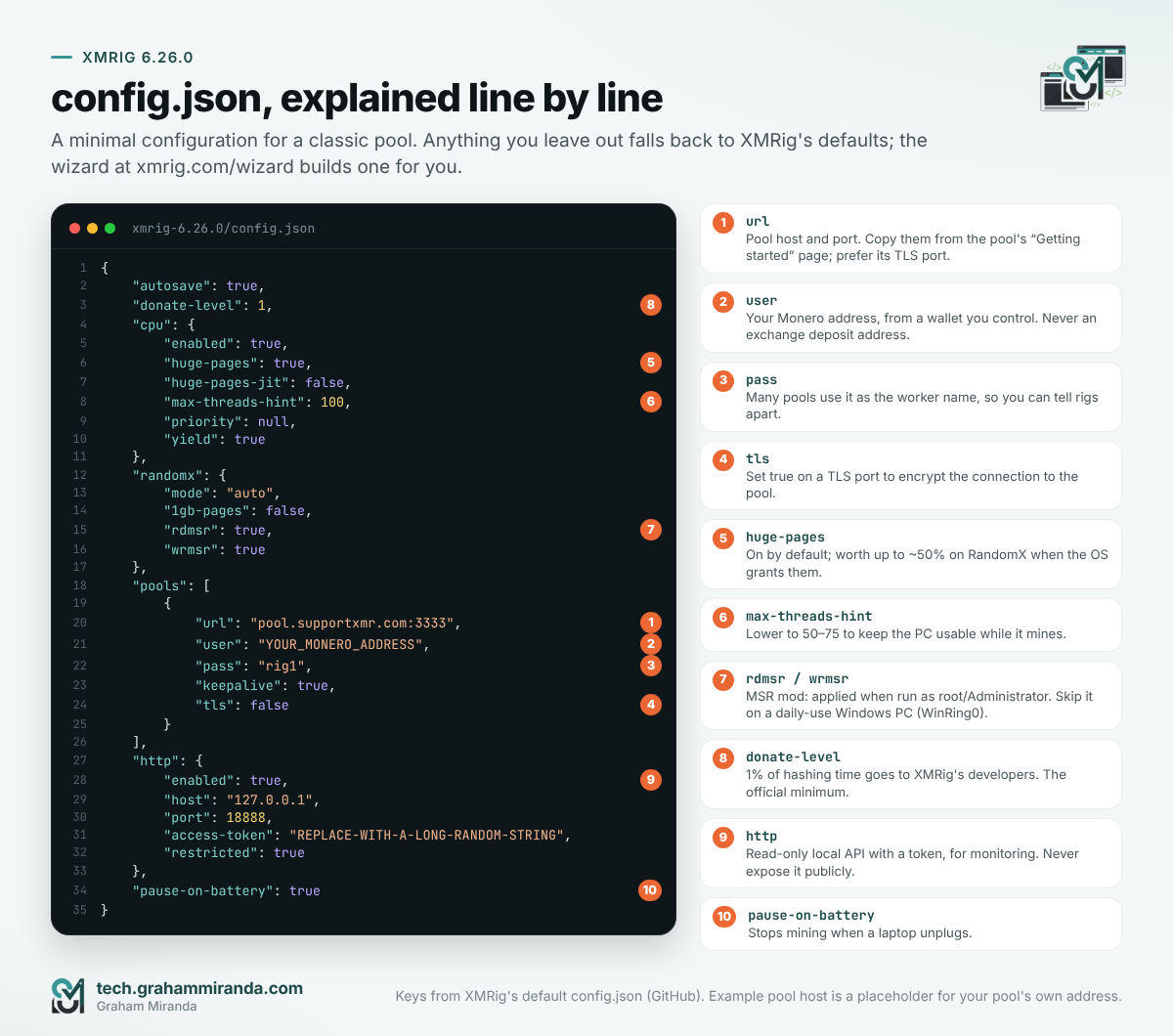
Step 5 — Huge pages, MSR and the other free speed-ups
RandomX keeps a dataset of about 2 GB in memory and hammers it randomly. Two settings make an enormous difference.
Huge pages (worth “up to 50%” for RandomX, according to XMRig’s documentation). On Linux, reserve 1,280 pages per NUMA node:
sudo sysctl -w vm.nr_hugepages=1280                              # until the next reboot
sudo bash -c "echo vm.nr_hugepages=1280 >> /etc/sysctl.conf"     # permanently
On Windows, XMRig needs the “lock pages in memory” privilege: run it as Administrator once and reboot, then check that the start-up log says HUGE PAGES permission granted. macOS doesn’t offer XMRig huge pages, which is one reason Macs trail their raw performance.
1 GB pages (Linux only) add another 1–3%. Set "1gb-pages": true in the randomx section and run XMRig as root, which configures them automatically.
The MSR mod switches off CPU hardware prefetchers that don’t help RandomX. XMRig applies it automatically when it runs as root on Linux or as Administrator on Windows, on Intel CPUs from Nehalem onwards and all AMD Zen processors. Gains vary by CPU, from a few percent to around 30% on some older Intel chips. One caution for Windows: the MSR mod uses the WinRing0 driver, which has a known privilege-escalation flaw (CVE-2020-14979), is abused by cryptojacking malware, and has been flagged by Microsoft Defender since 2025. On a Windows machine you use for anything else, I’d skip the MSR mod. On a dedicated Linux box, use it.
Memory matters as much as the CPU. RandomX wants dual-channel memory and about 2 MB of L3 cache per mining thread; XMRig picks the thread count from your cache automatically. A Ryzen 9 9950X with 64 MB of L3 runs 32 threads. The XMRig benchmark that reached 28.4 kH/s on that chip used fast DDR5 and 100% huge pages.
Step 6 — Run it and read the output
./xmrig            # Linux and macOS; on Windows, double-click xmrig.exe or run it from PowerShell
./xmrig --bench=1M # optional: a standard benchmark you can compare with others
In the first lines, look for huge pages at 100%, the RandomX dataset initialising, and your pool connection. After that, two kinds of line matter:
speed 10s/60s/15mshows your hashrate averaged over three windows. Judge your rig by the 15-minute figure.accepted (n/0)means the pool accepted your share. A growing second number (rejected shares) points to a connection or configuration problem.
Your pool’s dashboard will show your hashrate a few minutes later. Search for your address on the pool’s website.
Step 7 — Measure the wall power, then decide
Software reports what the CPU package draws, not what your PC pulls from the socket. Put the machine on a smart plug or energy meter for 24 hours, then run the breakeven formula from Part 1 with your real numbers. This is the step that turns “I think I’m making money” into a fact. More often than not, it turns it into a decision to stop, or to mine only on solar surplus.
Step 8 — Go decentralised: P2Pool with your own node
P2Pool is a pool without an operator. Miners keep a shared “sidechain” of shares, and every Monero block found pays everyone in the window directly from the block reward. There’s no fee, no account, no payout threshold to wait for and nobody who can be pressured, hacked or shut down. It needs your own Monero node, which also makes you a full participant in the network.
- Run a Monero node. Download Monero 0.18.5.4 and start the daemon with ZeroMQ enabled (from the P2Pool README;
--prune-blockchainkeeps disk use down to roughly a third of the full chain):./monerod --zmq-pub tcp://127.0.0.1:18083 --out-peers 32 --in-peers 64 \ --add-priority-node=p2pmd.xmrvsbeast.com:18080 --add-priority-node=nodes.hashvault.pro:18080 \ --enforce-dns-checkpointing --enable-dns-blocklist --prune-blockchain
With less than 10 Mbit/s of upload bandwidth, use --out-peers 8 --in-peers 16. Wait until it’s fully synced.
- Start P2Pool with your primary address (the one starting with
4), and--minifor a home-sized miner:./p2pool --host 127.0.0.1 --wallet YOUR_PRIMARY_ADDRESS --mini - Point XMRig at it. No wallet address is needed in XMRig, because P2Pool pays the address it was started with:
./xmrig -o 127.0.0.1:3333
Things worth knowing:
- Which sidechain? P2Pool runs three: main,
--miniand--nano. The usual advice is mini for home miners (below about 50 kH/s) and nano for very small rigs; main is for large operations. - Payouts come directly in Monero blocks. Your shares stay in the payout window for up to 2,160 pool blocks (about six hours), and the smallest possible payout is about 0.00027 XMR. With a small hashrate you won’t be paid in every block, but it averages out.
- Addresses on P2Pool are public, so use a wallet created just for mining. Subaddresses work today with the
--subaddressoption, but the P2Pool v5 beta built for Monero’s upcoming upgrade has dropped subaddress support, so the primary address is the future-proof choice. - Opening ports helps. Forwarding P2Pool’s port (37888 for mini, 37889 for main, 37890 for nano) and Monero’s 18080 on your router improves connectivity. If router settings are new territory, I explained the basics in what happens inside your router.
- Keep the box secure. A node that runs for months deserves basic hardening; my Debian 12 server hardening checklist covers the essentials.
Merge mining Tari costs you nothing extra once P2Pool is running. Start a Tari base node with --grpc-enabled --mining-enabled, then add one option to P2Pool:
./p2pool --host 127.0.0.1 --wallet YOUR_PRIMARY_ADDRESS --mini \
  --merge-mine tari://TARI_NODE_IP:18102 YOUR_TARI_ADDRESS
Tari is mined solo in this mode and doesn’t change your Monero payouts. P2Pool 4.18.1 requires a Tari node from version 6.0.0 onwards.
Run XMRig as a service (Linux)
On a dedicated Linux box, a small systemd unit keeps XMRig running after reboots:
# /etc/systemd/system/xmrig.service
[Unit]
Description=XMRig Monero miner
After=network-online.target
Wants=network-online.target

[Service]
ExecStart=/opt/xmrig/xmrig --config=/opt/xmrig/config.json
Restart=on-failure
Nice=10
# root lets XMRig set huge pages and the MSR mod itself; use a normal user if you set them up manually
User=root

[Install]
WantedBy=multi-user.target
sudo systemctl daemon-reload && sudo systemctl enable --now xmrig
journalctl -u xmrig -f # watch the outputIf an old Windows 10 PC is your spare machine, this is a good moment to move it to Linux anyway; my Windows 10 end-of-support guide covers the switch.
Mining on a Mac
XMRig ships native Apple silicon builds, and Apple chips are efficient: an M4 Pro manages about 6.8 kH/s at about 46 W, roughly 148 hashes per watt, better than most desktop CPUs. But there are no huge pages and no MSR mod on macOS, a MacBook isn’t designed for weeks at full load, and the absolute earnings are tiny (about €7.60 a month gross). On a Mac, mining is a lesson, not a business. If you bought a Mac for AI, my MacBook for local LLMs guide shows a far more valuable use of that silicon.
RandomX v2 and FCMP++: what changes for miners
Monero’s biggest upgrade in years is in testing:
- FCMP++ (Full-Chain Membership Proofs) replaces Monero’s 16-member ring signatures with proofs against the whole chain history, hiding each spent output among more than 150 million instead of 16. It comes with Carrot, a new address protocol designed to be backward compatible with today’s addresses.
- RandomX v2 reworks parts of the mining algorithm, for example making the rounding-mode instruction conditional and mixing more registers through AES. Monero’s pending code change switches block hashing to RandomX v2 at hard fork 17, the next network upgrade, and the FCMP++ test network already runs it. Early community benchmarks showed small gains on several Ryzen chips and an Apple M1 Pro, with older Intel chips roughly flat.
- Status: the FCMP++ and Carrot beta “stressnet” forked successfully on 5 October 2026, with RandomX v2 support included. Developers are working towards a non-binding target of around week 16 of 2027 (Q2 2027) for the main network, and no date is fixed.
What you need to do: keep XMRig at 6.26.0 or later (it already supports RandomX v2), update P2Pool and your Monero node when the fork date is announced, and keep your wallet software current. Pools will announce their own switch. If you own an Antminer X5, check Bitmain’s firmware news before the fork; whether RandomX v2 affects existing ASICs hasn’t been publicly confirmed.
Troubleshooting
| Symptom | Likely cause | Fix |
|---|---|---|
Antivirus deletes xmrig.exe |
Miners are flagged as unwanted software | Verify the hash; add a folder exclusion only for your own verified copy |
| Huge pages below 100% | Not enough pages reserved, or no permission | Linux: sysctl vm.nr_hugepages=1280 and reboot if memory is fragmented; Windows: run as Administrator once and reboot |
| Hashrate far below published benchmarks | Single-channel memory, throttling, huge pages off, power-saving profile | Dual-channel RAM, better cooling, huge pages, high-performance power plan; judge by the 15-minute average |
| Pool rejects your login | Typo in the address, or an exchange deposit address the pool doesn’t accept | Use an address from your own wallet; copy-paste, never retype |
| Many rejected or stale shares | Distant pool server, unstable connection | Pick the nearest region, enable keepalive, check Wi-Fi |
| No payouts on P2Pool for a while | Small hashrate on a busy sidechain | Use --mini or --nano, and wait; payouts average out |
| PC feels sluggish | All threads mining | max-threads-hint 50–75, keep yield on |
| Fans screaming, temperatures high | Sustained full load | Better cooling, a lower thread count, or don’t mine on that machine |
Part 5 — Crypto Wallets for Miners: Where Your Coins Should Land
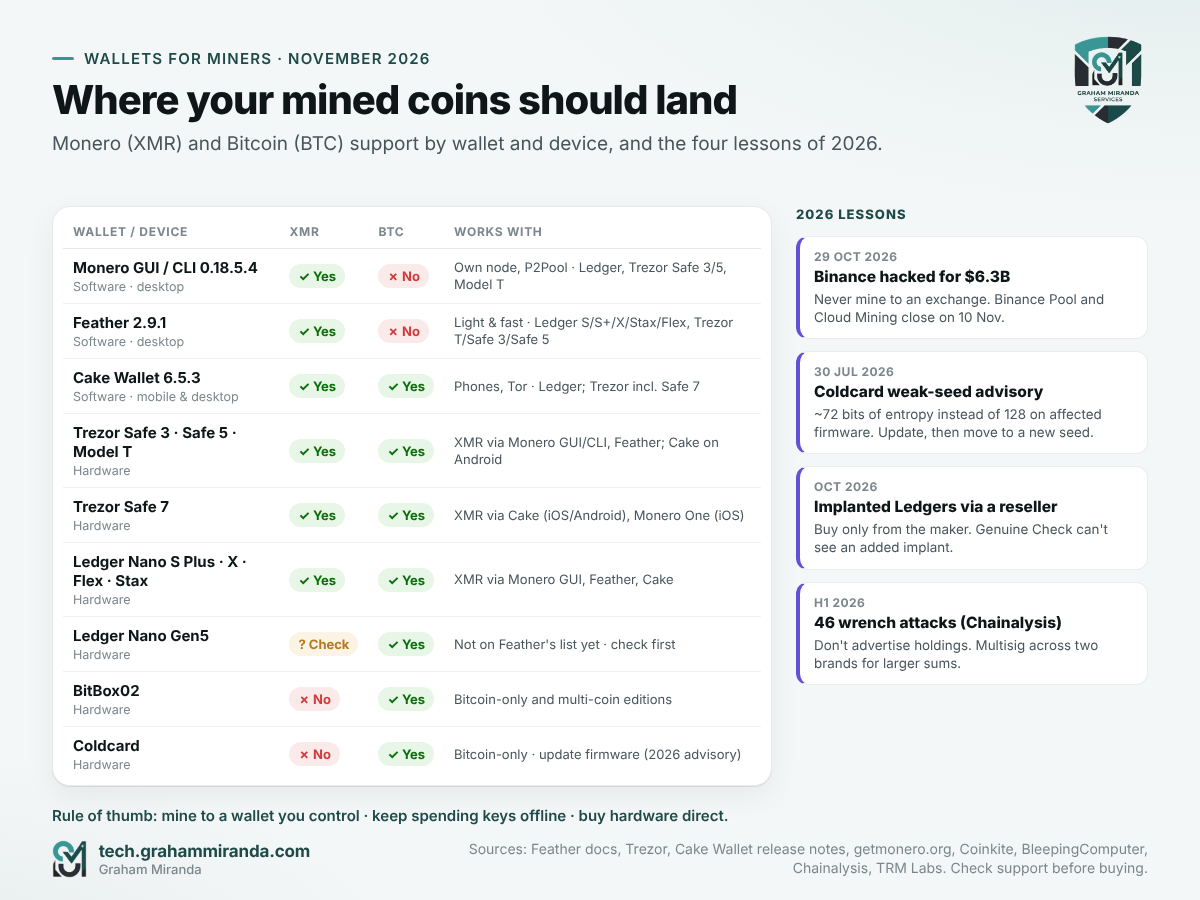
Mining creates coins. A wallet decides whether you keep them. The question of the best crypto wallet for mining comes down to one rule: your mining payouts go to an address you control, and the keys that can spend them live somewhere hackers and exchanges can’t reach.
Why “just leave it on the exchange” got worse this year
- Exchanges get hacked. On 29 October 2026, attackers drained about $6.3 billion in crypto from Binance’s hot wallets across ten blockchains in about twenty minutes, including roughly 18,270 BTC. TRM Labs and the FBI attributed it to North Korean hackers. Binance said it would cover all customer losses from its own funds, and began resuming withdrawals on 1 November. That was Binance’s decision, not a law of nature.
- Exchanges close mining products. Binance Pool and Binance Cloud Mining shut down on 10 November 2026.
- Exchanges restrict privacy coins. Kraken stopped Monero trading and deposits for customers in the European Economic Area at the end of 2024. Elsewhere it introduced rolling 30-day limits in August 2026: $1,500 in XMR withdrawals and $3,500 in deposits for individuals. In October it dropped intrusive questionnaires about what customers do with their XMR, after a backlash.
- The EU is closing the door for regulated platforms. From 10 July 2027, Article 79 of the EU’s Anti-Money Laundering Regulation (2024/1624) bars banks, financial institutions and crypto-asset service providers from keeping accounts in anonymity-enhancing coins such as Monero. Owning, mining and self-custodying them remains legal.
Wallet types in plain words
| Type | Who holds the keys | Good for | Risk |
|---|---|---|---|
| Exchange account (custodial) | The exchange | Buying and selling | Hacks, freezes, limits, closures |
| Software wallet on a computer or phone (hot) | You | Receiving payouts, small balances | Malware on that device |
| Hardware wallet (cold) | You, on a dedicated device | Long-term storage | Losing the seed; supply-chain tampering |
| Watch-only / view-only wallet | Nobody can spend from it | Watching payouts arrive | None for your funds; it reveals your balance to whoever has it |
| Multisig (e.g. 2-of-3) | You, split across devices | Larger amounts, inheritance | More setup, more to back up |
Monero wallets
| Wallet | Platforms | Version (Nov 2026) | Best for | Hardware wallets |
|---|---|---|---|---|
| Monero GUI / CLI | Windows, macOS, Linux | 0.18.5.4 (16 Oct) | Running your own node, P2Pool | Ledger; Trezor Safe 3, Safe 5, Model T |
| Feather | Windows, macOS 14+, Linux | 2.9.1 (2 Nov) | A light, fast desktop wallet with Tor | Ledger Nano S, S Plus, X, Stax, Flex; Trezor Model T, Safe 3, Safe 5 (not yet Safe 7) |
| Cake Wallet | Mobile and desktop | 6.5.3 (Nov) | Phones, multi-coin, built-in Tor | Ledger; Trezor (Monero since 6.2), including Safe 7 |
Bitcoin wallets
For Bitcoin mining payouts, the boring choices are the right ones: Sparrow Wallet on a desktop to coordinate a hardware wallet (and multisig, when you get there), Bitcoin Core if you run your own node, or your hardware wallet maker’s own app. Avoid wallets you’ve never heard of that appear in app-store ads; fake wallet apps remain one of the oldest scams in crypto.
Hardware wallets and Monero support
| Device | Monero (XMR) | How | Notes |
|---|---|---|---|
| Trezor Safe 3, Safe 5, Model T | ✅ | Monero GUI or CLI, Feather; Cake Wallet on Android | Trezor’s own Suite app doesn’t handle XMR |
| Trezor Safe 7 | ✅ | Cake Wallet (iOS and Android), Monero One (iOS) | Not yet supported by Feather or the Monero GUI |
| Ledger Nano S Plus, Nano X, Flex, Stax | ✅ | Monero GUI, Feather, Cake Wallet | Ledger’s own app doesn’t manage XMR |
| Ledger Nano Gen5 | ❓ | — | Not on Feather’s supported list in November 2026; check before buying |
| BitBox02 | ❌ | — | Bitcoin-only and multi-coin editions; no Monero |
| Coldcard | ❌ | — | Bitcoin-only; see the 2026 advisory below |
The 2026 hardware wallet scares
Two incidents this year are worth understanding, because neither was the kind of “hack” people imagine.
Coldcard’s weak seeds. On 30 July 2026, Coinkite published an advisory: a firmware flaw in seed generation meant affected devices produced seeds with about 72 bits of entropy instead of the expected 128, weak enough for attackers to regenerate private keys offline. Affected: Mk2 and Mk3 firmware 4.0.1–4.1.9, Mk4/Mk5 before 5.6.0, Q before 1.5.0Q, and the Edge firmware tracks before their fixed versions. Seeds created with at least 50 private dice rolls weren’t considered at risk, and a strong BIP-39 passphrase gave some protection, but Coinkite’s advice was to update the firmware and move funds to a newly generated seed, because a firmware update can’t repair an existing weak seed.
Ledger’s implanted devices. In October 2026, Ledger confirmed that devices sold through CryptoBilis, a Malaysia-based reseller, included at least one with an unauthorised hardware implant. Researchers described an implant that captured the screen and button presses to steal the seed, then sent it out over LTE using an eSIM. Researchers reported that tampered units sold for about half the normal price. Ledger’s “Genuine Check” cannot detect an added implant if the secure chip itself is untouched. Reports in October put losses at roughly $86 million.
The lessons are the same for every brand:
- Buy only from the manufacturer or an authorised reseller. A hardware wallet at half price is a red flag, not a bargain.
- Update firmware, and when a vendor says “migrate to a new seed”, do it.
- Add your own entropy (dice rolls) when your device supports it.
- Use a passphrase (sometimes called the “25th word”) for serious amounts, and back it up separately.
- For larger sums, use multisig across two brands. A 2-of-3 setup with devices from different makers would have survived both incidents above.
Seed phrases: the rules that actually matter
- Write it on paper or stamp it into metal. Never photograph it, type it into a computer, or store it in a password manager or cloud note.
- Nobody legitimate will ever ask for it: not support, not a “wallet validation” site, not a pool.
- Test a restore with a small amount before you trust a backup.
- Plan for inheritance: someone you trust should know that the coins exist and how to reach a professional who can help, without being able to take them.
The $5 wrench problem
The most underrated wallet risk in 2026 isn’t digital. Chainalysis counted 46 violent theft attempts against crypto holders in the first half of 2026, more than $30 million stolen, and 30 incidents in France alone. CertiK counted 52 incidents and $124 million in exposure for the same period, with home invasions now a large share. A hardware wallet in a drawer doesn’t help if someone can force you to unlock it.
So: don’t talk about your holdings online or at meetups, don’t post photos of your mining setup with its address or location, keep exchange accounts in your name to the minimum needed, and for larger amounts use multisig with geographically separated keys or a time delay, so that no single person in a room can move everything.
Setting up a payout wallet: two recipes
Monero:
- Create a new wallet in Feather or the Monero GUI on a clean computer and write down the seed.
- Use the primary address for P2Pool, or a fresh subaddress per pool or rig for classic pools, so you can tell payouts apart.
- Create a view-only wallet on your phone from the secret view key, to watch payouts arrive without any ability to spend.
- Every few weeks, move the balance to cold storage: a Trezor or Ledger wallet set up through Feather, the Monero GUI or Cake Wallet.
Bitcoin:
- Set up your hardware wallet with Sparrow Wallet, verify a receive address on the device’s screen, and use a fresh address for your pool payouts.
- Set a payout threshold high enough that fees stay negligible, and consolidate small payouts when network fees are low.
- Never reuse addresses (see below).
Address reuse, privacy and quantum computers
Every time a Bitcoin address is spent from, its public key becomes visible on the chain. Today that’s mostly a privacy issue. Tomorrow it may be a security one: a sufficiently powerful quantum computer could, in theory, derive a private key from an exposed public key. In February 2026, Bitcoin developers merged BIP-360 (pay-to-Merkle-root, “P2MR”) into the BIP repository as a first proposal for quantum-resistant outputs. It’s a proposal, not an activated upgrade. Around 6.5 million BTC sit in addresses whose public keys are already exposed. The practical advice for miners is old and good: use a new address for every payout, and don’t leave large balances on addresses you’ve spent from. For the hardware side of the quantum story, see my piece on Google’s Willow quantum chip.
Part 6 — Crypto Mining Trends 2026: What’s Actually Changing
These are the crypto mining trends of 2026 that matter, ranked by how much they’ll affect you as a small miner, not by how loudly they were reported.
1. Hashprice near record lows, and a fee drought
Bitcoin’s hashprice hit an all-time low of $27.74 per PH/s per day on 6 June 2026, recovered to about $40 by 1 October, then slid to about $33 by 1 November after the Binance hack knocked the price down. Fees made up just 0.66% of block rewards in October. Bitcoin miners are living almost entirely on a subsidy that halves in about eighteen months. That’s the single most important fact in Bitcoin mining today.
2. Bitcoin miners are turning into AI landlords
The listed miners own something AI companies desperately want: big grid connections, cooling and permitted industrial sites. So they’re renting them out:
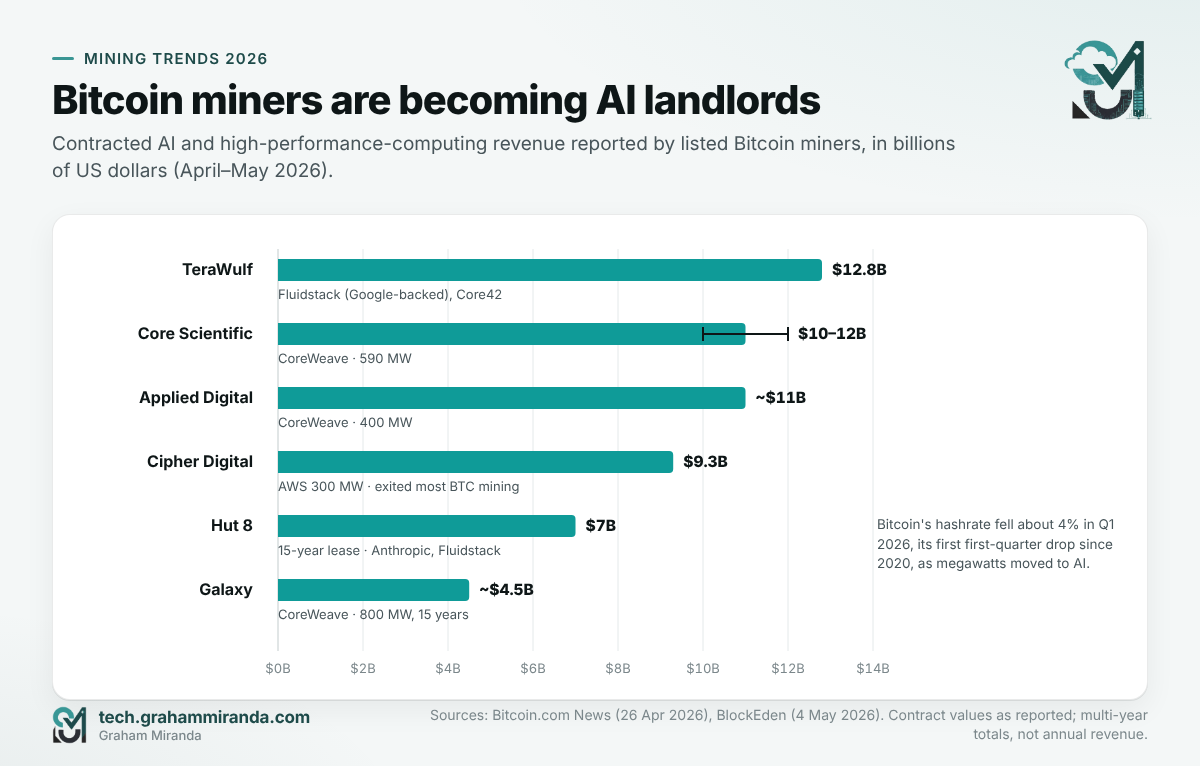
- TeraWulf has more than $12.8 billion in contracted high-performance computing revenue, with leases to Google-backed Fluidstack and Core42.
- Hut 8 signed a $7 billion, 15-year lease at its River Bend campus with Anthropic and Fluidstack.
- Core Scientific has roughly $10–12 billion contracted through CoreWeave; Applied Digital about $11 billion; Galaxy about $4.5 billion over 15 years.
- Cipher Digital (formerly Cipher Mining) has a $9.3 billion backlog anchored by a 300 MW Amazon Web Services deal, and has exited most of its Bitcoin operations.
By late April, several of these stocks were up 40–74% for the year while Bitcoin was down about 12%, and analysts expected some of them to earn around 70% of 2026 revenue from AI hosting. Bitcoin’s hashrate even dipped about 4% in the first quarter of 2026, the first first-quarter decline since 2020. For small miners, this cuts both ways: power-hungry AI competes for the same cheap electricity, but miners leaving for AI also slows difficulty growth. It’s also a reminder of where the AI boom is getting its megawatts.
3. The efficiency race and the 1 ZH/s network
Bitcoin’s seven-day average hashrate crossed 1,000 EH/s again on 11 October 2026 and reached about 1,088 EH/s on 26 October. The machines doing it are hydro-cooled and rack-mounted: the Antminer S23 Hyd reaches 9.5 J/TH, and its 3U version pushes 1.16 PH/s from a single unit drawing 11 kW. Air-cooled machines that home miners can actually run are now two generations behind the best industrial hardware.
4. The home-mining revival
At the other end of the scale, open-source and quiet home miners are booming: Bitaxe boards that sip 20 W, NerdQaxe units with four chips, and Canaan’s Avalon Q, a 90 TH/s miner designed as a heater with an Eco mode under 40 dB. Solo-mined blocks have become regular news, with 24 in the twelve months to July 2026, up 41% on the year before. It isn’t a business, but it does put a few more independent miners on the network, and that’s good for Bitcoin.
5. Privacy coins: a boom and a squeeze
Monero rose about 70% in a year and nearly touched $800 in January. Zcash rallied from $184 to more than $1,200 on growing use of shielded transactions. At the same time, the walls are going up: Kraken’s XMR limits, the EU’s July 2027 ban on regulated platforms handling anonymity-enhancing coins, and constant political pressure whenever hackers swap stolen funds into Monero. Expect privacy coins to keep moving away from exchanges and towards self-custody, peer-to-peer trading and atomic swaps. That makes knowing how to mine and hold them yourself more relevant, not less.
6. Monero’s year of outsiders
Monero spent 2025–2026 fending off outsiders. In August 2025, Qubic, a project that pays its miners partly with outsourced Monero mining, claimed to control a majority of Monero’s hashrate. In September 2025, the network suffered an 18-block reorganisation that invalidated more than 100 transactions; no one was conclusively blamed, but it reignited the debate. One practical result for home miners: the node command in P2Pool’s README enables DNS checkpointing (--enforce-dns-checkpointing, in the command above), which the README says is needed “to combat the selfish mining attempts by malicious actors”. In April 2026, Qubic began moving its outsourced mining to Dogecoin, and by late October it no longer appeared among Monero’s largest pools. Then came Bitmain’s X9, announced in December 2025 and reportedly cancelled in May 2026, and the preparation of RandomX v2 for the FCMP++ upgrade. The lesson for miners: pool concentration is a security problem, and P2Pool is the fix you can apply yourself.
7. Proof-of-useful-work
The oldest criticism of mining is that the work is useless. New coins try to answer it. Pearl makes miners compute matrix multiplications, the core arithmetic of AI, and launched its mainnet in April 2026. Qubic routes miners’ CPUs towards training its own AI. Hashrate Index’s verdict on Pearl was cautious: much of the “useful” work is inference nobody asked for, liquidity is thin, and rewards fall as more GPUs join. It’s a trend to watch, not yet a reason to buy hardware.
8. Pools: concentration, exits and new protocols
Pool concentration is high on both big networks: about two-thirds of recent Bitcoin blocks came from three pools, and about 60% of Monero’s hashrate sat with three pools in October. One giant is leaving: Binance Pool closes on 10 November 2026, along with Binance’s cloud mining. On the other side, protocols that let individual miners choose their own block templates, such as Stratum V2 and OCEAN’s DATUM, keep growing, and Monero’s P2Pool has no operator at all.
9. Regulation: MiCA, AMLR, DAC8 and an American stalemate
- EU: MiCA’s transition periods for crypto-asset service providers have ended, the AMLR privacy-coin rule applies from 10 July 2027, and the EU’s tax-reporting directive DAC8 has applied since 1 January 2026.
- Germany: the Kryptowerte-Steuertransparenzgesetz (KStTG) implements DAC8. Crypto service providers now collect customer data and report it annually to the Federal Central Tax Office (BZSt), by 31 July for the previous year. Part 7 explains what that means for miners.
- United States: the Senate failed to advance the CLARITY Act, the crypto market-structure bill, in a 49–50 cloture vote on 15 September 2026, leaving US market rules in limbo.
10. Security: exchange hacks, cryptojacking and wrench attacks
The $6.3 billion Binance hack on 29 October was the largest theft in crypto history. Cryptojacking keeps evolving: a wormable campaign documented by Trellix in February 2026 spread XMRig through pirated software and abused the WinRing0 driver to boost its hashrate; Censys documented a campaign in April that targeted more than 1,000 exposed ComfyUI servers and turned compromised ones into miners; and Trend Micro showed a Langflow flaw (CVE-2026-33017) being used to drop a customised XMRig in the spring. If you run AI tools such as ComfyUI or Langflow on a server, don’t expose them to the internet without authentication: somebody else will happily mine Monero on your GPU and your power bill. And physical “wrench attacks” on crypto holders are on track for a record year (Part 5).
11. The 2028 halving
Bitcoin’s subsidy halves at block 1,050,000, expected around April 2028, from 3.125 to 1.5625 BTC. Every Bitcoin miner’s revenue halves that day unless the price doubles or fees explode. Any Bitcoin hardware you buy now has about eighteen months to earn its keep at today’s subsidy.
12. Quantum: the first careful steps
BIP-360’s merge in February 2026 was the first concrete step towards quantum-resistant Bitcoin outputs. There’s no activation date and no consensus yet. For now, it’s a reason to stop reusing addresses, not a reason to panic.
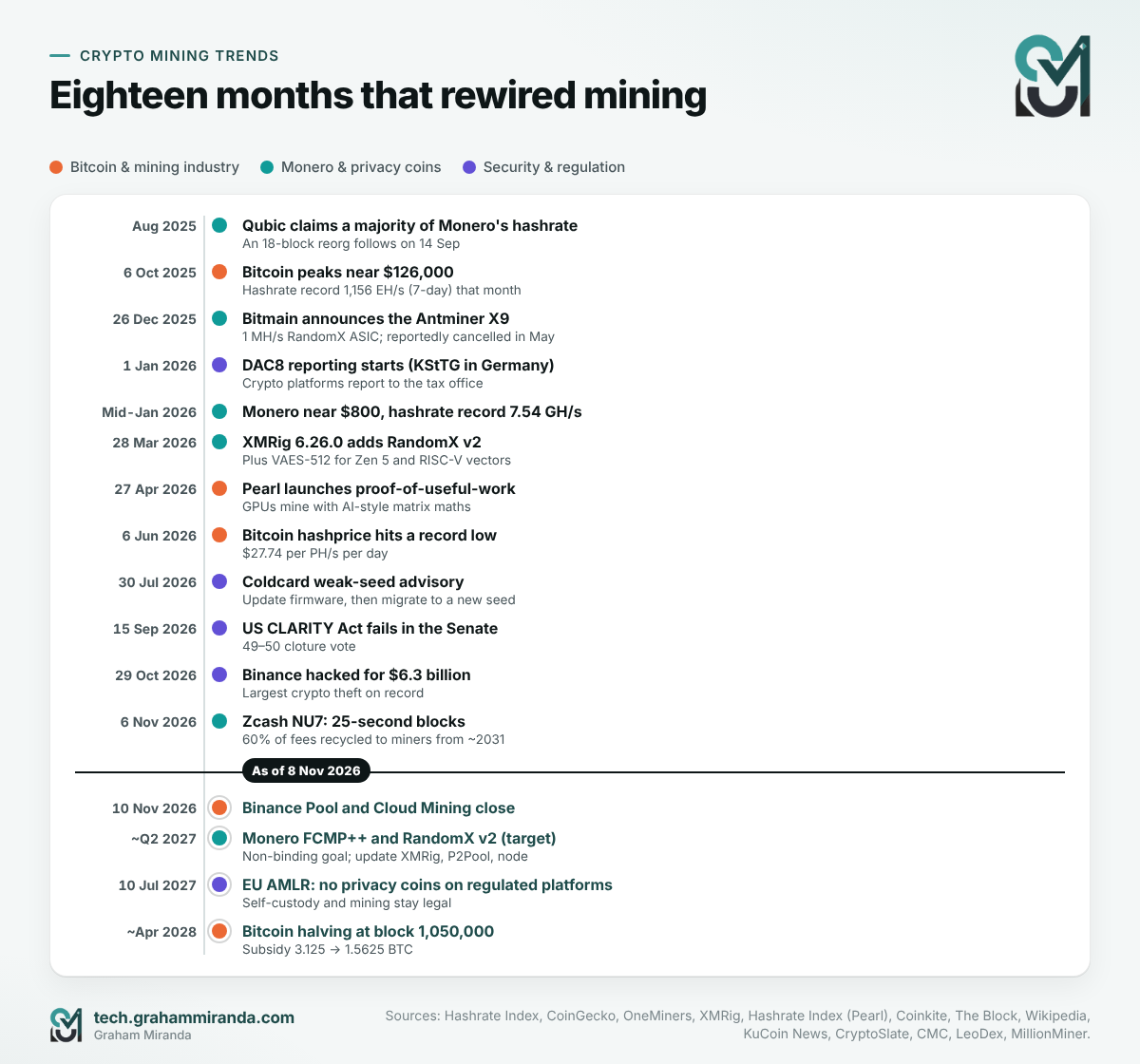
Part 7 — Crypto Mining in Germany: Tax, Power and Paperwork
This part is a summary for orientation, not tax or legal advice. Rules depend on your circumstances; if mining becomes more than a hobby, talk to a Steuerberater before the first payout, not after the first letter from the Finanzamt.
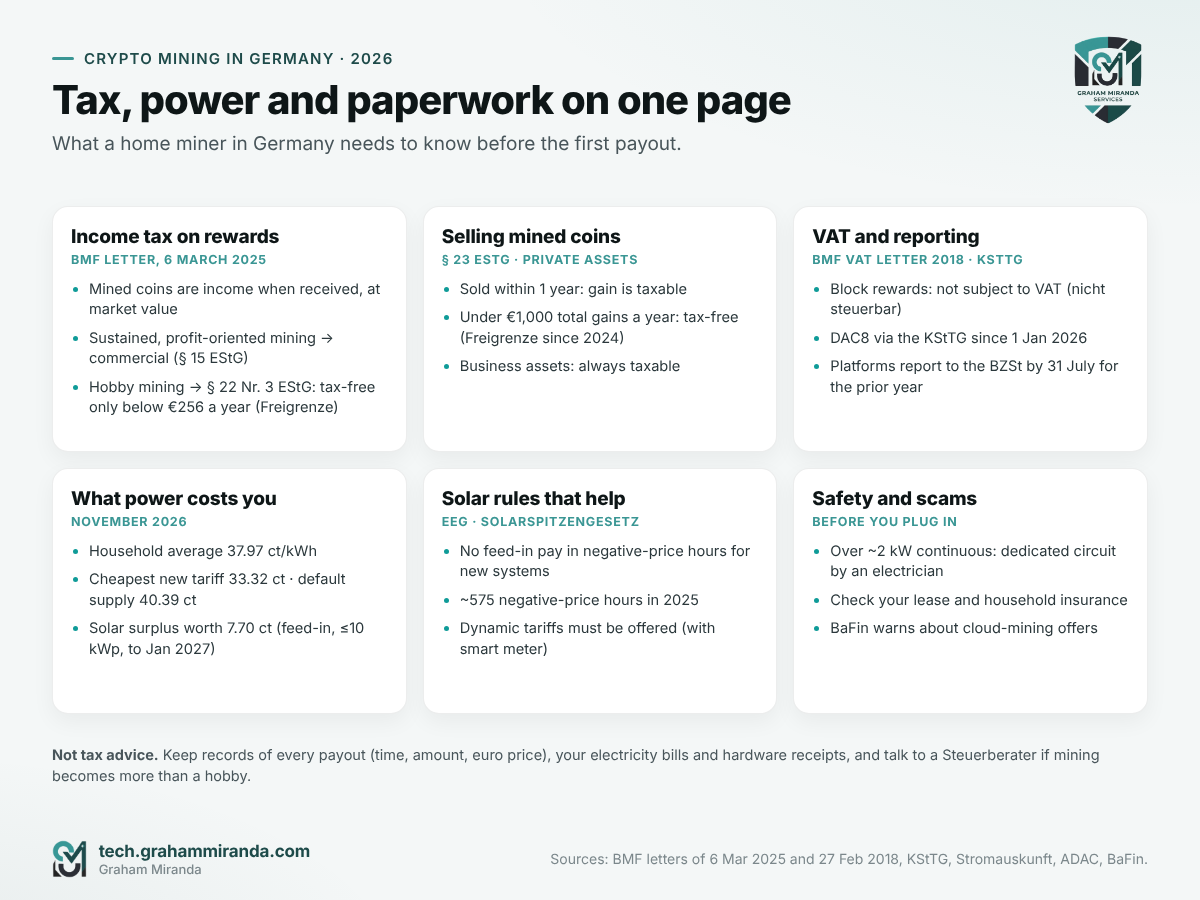
Is crypto mining legal in Germany?
Yes. Germany doesn’t ban mining, and mining coins for yourself on your own hardware isn’t a licensed financial activity. Selling mining contracts or “cloud mining” to other people is a different matter, and BaFin has warned consumers about such offers (more below).
Income tax: the BMF letter of 6 March 2025
The Federal Ministry of Finance’s letter on crypto assets (BMF-Schreiben of 6 March 2025) is the reference. In short:
- When you receive mined coins, that’s income. The coins are valued at their market price when you receive them, and that value is taxable.
- Commercial or not? If your mining is sustained, carried on with the intention of making a profit and part of general economic activity, it’s commercial income (Einkünfte aus Gewerbebetrieb, § 15 EStG). Commercial mining means registering a business (Gewerbeanmeldung), possible trade tax (Gewerbesteuer), and that your mined coins become business assets, so selling them is always taxable, however long you hold them. Electricity and depreciation on hardware then count as business expenses.
- Hobby-scale mining that doesn’t qualify as commercial is treated as other income from services under § 22 Nr. 3 EStG. It’s tax-free only if all such income in the calendar year stays below €256 in total. That’s a Freigrenze: go one euro over and the whole amount is taxable.
- Selling coins later: coins held as private assets are subject to the private-sale rules of § 23 EStG. Sell within one year of receiving them and the gain (sale price minus the value at which you received them) is taxable; gains below €1,000 per year in total are tax-free (a Freigrenze since 2024). After a year, the gain is tax-free.
- Loss-making hobby mining may not be recognised for tax purposes at all if there’s no prospect of an overall profit.
Record-keeping is the part people regret skipping. Export your pool’s payout history regularly (dashboards don’t keep it forever), note the timestamp, amount and euro price of every payout, keep electricity bills and hardware receipts, and track each batch of coins until you sell it.
VAT
The Federal Ministry of Finance’s VAT letter of 27 February 2018 treats mining rewards as not subject to VAT (nicht steuerbar), because there’s no identifiable customer for the block reward. Exchanging crypto for euros is VAT-exempt under the EU’s rules for currency exchange.
DAC8 and the KStTG: what the tax office now sees
Since 1 January 2026, crypto service providers operating in Germany have collected customer and transaction data under the KStTG, and they report it every year to the Federal Central Tax Office by 31 July for the previous calendar year. The first reports cover 2026. Existing customers have to provide tax self-certification. What this means for miners: mining payouts that go straight to your own wallet aren’t reported by a pool or exchange, but the moment you sell through a regulated platform, the tax office learns about it. Your obligation to declare mining income doesn’t depend on anyone reporting it.
Electricity, solar and the grid
- Prices: about 37.97 ct/kWh on average, 33.32 ct for the cheapest new contracts, 40.39 ct in default supply (November 2026).
- Solar feed-in: 7.70 ct/kWh for partial feed-in systems up to 10 kWp commissioned from August 2026 to January 2027. Systems under the Solarspitzengesetz (since 25 February 2025) get no payment during negative-price hours.
- Coming reform: the government plans to end the fixed feed-in tariff for new systems under 25 kWp, with a transition of up to 36 months at around 5.2 ct/kWh; it’s still going through parliament, and systems commissioned by 31 December 2026 aren’t affected. If that happens, surplus solar becomes even cheaper to mine with.
- Dynamic tariffs: every supplier must offer one to customers with a smart meter. They make “mine only when power is cheap” automation possible.
Safety, noise and your landlord
- A standard Schuko socket is rated for 16 A, but it isn’t designed to run near that limit for hours on end, and extension leads even less so. Anything above about 2 kW running continuously belongs on a dedicated circuit, installed by a qualified electrician (often with a CEE socket).
- Noise: industrial ASICs run at 75 dB or more, lawnmower territory, around the clock. Quiet-mode home miners exist for a reason.
- Rented flats: check your rental agreement and talk to your landlord before you install anything that draws kilowatts all day, and make sure your household insurance knows what you’re running.
Cloud mining and “mining apps”
BaFin warns that cloud-mining offers often come from dishonest operators, that providers may not mine anything at all, and that investors often try in vain to get their money back. If an app promises fixed daily returns from “mining”, it’s almost certainly a scam. Even large legitimate players have left the business: Binance closes its cloud-mining product on 10 November 2026.
Part 8 — Twelve Mistakes New Miners Make
- Buying hardware before running the breakeven formula with your real electricity price.
- Mining to an exchange address. Pools close, exchanges limit or delist coins, and hacks happen. Mine to your own wallet.
- Mining on hardware you don’t own or electricity you don’t pay for: your employer’s PCs, a cloud VPS, a shared server. It’s against terms of service at best and a crime at worst.
- Downloading XMRig from anywhere except its official releases page, or running an “optimised” build from a video description. That’s how miners get infected.
- Exposing a miner’s API, an AI tool or a node to the internet without authentication. Attackers scan for exactly that.
- Trusting software power readings. Measure at the wall for 24 hours.
- Running a 3 kW machine on a Schuko extension lead.
- Mining on a laptop 24/7. Heat kills batteries and fans.
- Believing cloud-mining apps or anyone promising fixed daily returns.
- Forgetting the tax side, especially the €256 threshold and the record-keeping.
- Skipping updates before a network upgrade. Monero’s FCMP++ and RandomX v2 fork will require current XMRig, P2Pool and node software.
- Advertising your setup. Photos of your rig, your earnings dashboard and your location are a gift to the wrong people.
Part 9 — Should You Mine? Seven Scenarios
1. “I have a gaming PC and pay normal German power prices.”
Don’t mine around the clock; you’ll pay about €1.77 for every euro of Monero you earn. Do try XMRig for a weekend to learn how mining works, mine through P2Pool, and stop there. If you want XMR, buy it.
2. “I have solar panels.”
This is where mining makes sense in Germany. Mine Monero with a CPU, or run a small Bitcoin miner, on surplus power only, ideally automated from your inverter’s surplus signal (Home Assistant can switch loads based on export). In summer, a Zcash or RandomX ASIC can run in the black, if you have the space, a dedicated circuit and tolerance for noise.
3. “I want to own Bitcoin.”
Buy it, and put it on a hardware wallet. Get a Bitaxe if you want the fun of solo mining and the tiny chance of a $238,000 surprise, and budget about €67 a year for the electricity.
4. “I want to support Monero’s decentralisation.”
Run your own Monero node and P2Pool mini with XMRig, ideally on a low-power machine you already own and on cheap hours. It’s one of the most useful things a small miner can do for any network today.
5. “I have an RTX 4090 or 5090.”
Rent it out on a GPU marketplace or use it for local AI. Mining the best liquid coin earns about $1.40 a day; renting can gross several times that.
6. “I run a business with spare servers.”
Don’t mine on them: the electricity, the terms of your hosting or colocation contract, depreciation and the tax treatment all work against you. Do make sure nobody else mines on them. Unexpected 100% CPU on a server is one of the first signs of cryptojacking, and monitoring for it is a basic part of managed IT.
7. “I want passive income.”
Mining isn’t passive income at German household prices; it’s a hobby with an electricity bill, or a capital-intensive business elsewhere. And any app promising daily returns from cloud mining is the opposite of passive income: it’s a way to lose money on autopilot.
Frequently Asked Questions
For most people in Germany, no. At the average household price of about 37.97 ct/kWh, Bitcoin ASICs, GPUs and normal PCs all lose money. Mining can pay on solar surplus (worth about 7.70 ct/kWh to you), on very cheap or hosted power, or with a Zcash Z15 Pro while ZEC trades above about $880. Learning, privacy and supporting a network are good reasons to mine; profit at household prices isn’t.
By hardware class, Zcash on Equihash ASICs is the most profitable in November 2026: an Antminer Z15 Pro grossed about $40 a day at a ZEC price around $1,262. For CPUs, Monero (XMR) with XMRig is the standard choice. For GPUs, the best liquid coin, Tari’s C29 lane, earns an RTX 5090 only about $1.40 a day, so renting the card to AI users usually pays more.
No. At a hashprice of about $33 per PH/s per day, even the efficient Antminer S23 needs electricity below about 11 ct/kWh, while German households pay around 38 ct. Bitcoin would need to trade near $262,000 for an S23 to break even at household prices. Home Bitcoin mining makes sense only as a solo-mining hobby with a Bitaxe, as a heater replacing direct electric heating, or on solar surplus.
A tuned Ryzen 9 9950X (about 28 kH/s) earns roughly 0.0019 XMR, about €1, a day before electricity; an Apple M4 Pro about 0.00046 XMR, about €0.25. At 37.97 ct/kWh, both lose money: the 9950X about €0.79 a day, the M4 Pro about €0.17. Your result depends on XMR’s price, the network hashrate and your measured power draw.
XMRig is the most widely used open-source Monero miner. Version 6.26.0 was released on 28 March 2026 for Windows, Linux, macOS and FreeBSD. The official build is safe when downloaded from its GitHub releases page and verified against the published SHA-256 checksums. Antivirus tools often flag it because criminals bundle XMRig into malware, so never use copies from videos, forums or unofficial “optimised” builds.
Yes. Pools pay to an address, and it should be one you control, not an exchange’s. For Monero, use Feather (2.9.1), the official Monero GUI (0.18.5.4) or Cake Wallet (6.5.3), and move larger balances to a Trezor or Ledger hardware wallet. For Bitcoin, use a hardware wallet with Sparrow Wallet. Buy hardware wallets only from the manufacturer.
Yes. XMRig ships native Apple silicon builds, and an M4 Pro mines Monero at about 6.8 kH/s on about 46 W, which is very efficient. But macOS doesn’t give XMRig huge pages, earnings are tiny (about €7.60 a month gross) and MacBooks aren’t built for weeks at full load. Treat it as a way to learn, not as income.
For profit, mostly. The best liquid coin earns an RTX 5090 about $1.40 a day. New coins such as Pearl show higher paper profits but trade on small exchanges with thin liquidity. Renting a high-end GPU to AI customers, at roughly $0.30–0.60 per hour for an RTX 5090 host, or using it for local AI, is almost always the better use of the card.
P2Pool is a decentralised Monero mining pool with no operator, no fees and no payout threshold. Payouts come directly from each Monero block. It needs your own Monero node, then p2pool --mini with your primary address and XMRig pointed at 127.0.0.1:3333. Use it if you can: three classic pools held about 60% of Monero’s hashrate in October 2026, and P2Pool reduces that concentration.
Rarely. BaFin warns that cloud-mining offers often come from dishonest operators who may not mine at all, and that investors frequently can’t get their money back. Any app or website promising fixed daily returns from mining should be treated as a scam. Even Binance shuts its cloud-mining product on 10 November 2026.
Under the BMF letter of 6 March 2025, mined coins are income when received, valued at their market price. Sustained, profit-oriented mining is commercial income (§ 15 EStG). Hobby mining falls under § 22 Nr. 3 EStG and is tax-free only if all such income stays below €256 a year. Selling privately held coins within a year is taxable under § 23 EStG, with a €1,000 annual exemption threshold. This isn’t tax advice.
Mining continues, with a reworked algorithm. RandomX v2 is planned to switch on at hard fork 17, Monero’s next network upgrade, alongside FCMP++, which developers are loosely targeting for around Q2 2027; the test network forked on 5 October 2026. Miners need XMRig 6.26.0 or later, which already supports RandomX v2, plus updated P2Pool and node software once a date is set.
Yes, but rarely. A Bitaxe at about 1.2 TH/s has roughly a 0.006% chance per year, about one block every 16,600 years on average at today’s 1,050 EH/s network. It does happen: a Bitaxe found block 957,382 in July 2026 and won 3.1382 BTC, and solo miners found 12 blocks in 2026 by mid-July. Budget it as a lottery ticket that costs about €67 a year in German electricity.
Yes. Mining isn’t banned in Germany or the EU, and mining for yourself doesn’t require a licence. What’s restricted is regulated platforms: from 10 July 2027, EU banks and crypto service providers may not handle anonymity-enhancing coins such as Monero. Holding, mining and self-custodying them stays legal. Mining income is taxable.
Not for individuals. The EU’s Anti-Money Laundering Regulation (Article 79) applies from 10 July 2027 and stops banks and crypto-asset service providers from keeping accounts in anonymity-enhancing coins. You can still own, mine and self-custody Monero and trade it peer-to-peer. In practice, buying and selling XMR through EU-regulated exchanges will become much harder.
The Bottom Line
So, is crypto mining worth it in 2026? As a business at German household prices, almost never. Bitcoin is an industrial game won by companies paying a sixth of your electricity price, and even they are turning their sites into AI data centres. GPUs have better jobs to do. The one ASIC category that clears German retail rates today, Zcash’s Equihash machines, does so on a coin that traded at $184 this year.
As something else, mining is still worth a lot. It’s the best way to understand how these networks actually work. It’s a rational use of solar power that would otherwise earn you 7.70 cents, or nothing at all during negative-price hours. It’s a way to support Monero’s decentralisation through P2Pool, and to receive coins straight from the network into a wallet you control. And it’s a cheap, fun lottery ticket with a Bitaxe.
If you do mine, do it properly: run the breakeven formula with your real tariff, download XMRig only from its official page, mine to your own wallet, keep the spending keys on hardware bought from the manufacturer, keep records for the Finanzamt, and update before Monero’s FCMP++ upgrade. And whatever you mine, the question “would I be better off just buying the coin?” deserves an honest answer before the first kilowatt-hour.
Mining at home in Germany? I’d like to hear what you pay per kWh, what you mine and what your wall-meter says. Corrections and counter-evidence are welcome; this article gets updated as the numbers change.
Disclosure: This article contains no affiliate links and no sponsored content, and it isn’t financial, investment or tax advice. My company, Graham Miranda UG (haftungsbeschränkt), provides hosting and IT services and earns nothing from any hardware, pool, wallet or coin mentioned. No company mentioned here reviewed or approved this article.
Last updated: 9 November 2026.