 English
  Deutsch
  Español
  Italiano
  Français
In 2012, the best computer-vision systems on Earth still fumbled at telling a dog from a cat. In 2026, you can type one sentence and watch a photorealistic thirty-second film assemble itself — camera moves, cinematic lighting, synchronized dialogue and all — in less time than it takes to pour a coffee.
That is not a decade of steady progress. That is a different planet.
The story of how artificial intelligence got here is one of the strangest acceleration curves in the history of technology. For fifty years it crawled. Then, in the span of roughly ten, it sprinted past milestones that researchers once assumed were generations away. If you have felt whiplash trying to keep up — new model names every few weeks, capabilities that seemed impossible last spring showing up as free features this summer — you are not imagining it. The pace really is that fast, and it is still accelerating.
This is the complete, human history of that acceleration: where AI came from, the handful of breakthroughs that changed everything, the arms race between closed and open models, the rise of AI image and video generation, and where the whole thing is heading next.
Grab that coffee. This is a long one.
Table of contents
- The Long, Slow Road: AI Before the Boom (1950–2011)
- The Spark: How Deep Learning Ignited in 2012
- The Architecture That Changed Everything: Transformers (2017)
- The GPT Era and the Birth of the Modern LLM (2018–2022)
- ChatGPT: The Week AI Went Mainstream
- The Closed-Model Arms Race (2023–2026)
- The Open-Model Revolution: Weights for the People
- When AI Learned to See and Paint: The Image-Generation Story
- When AI Learned to Move: The Rise of AI Video
- Beyond Text and Pixels: Voice, Multimodality, and the Age of Agents
- Why Did AI Suddenly Move So Fast?
- Where AI Goes Next
- Frequently Asked Questions
The Long, Slow Road: AI Before the Boom (1950–2011)
It is tempting to think artificial intelligence was invented around 2022. It was not. The dream is nearly as old as the modern computer itself.
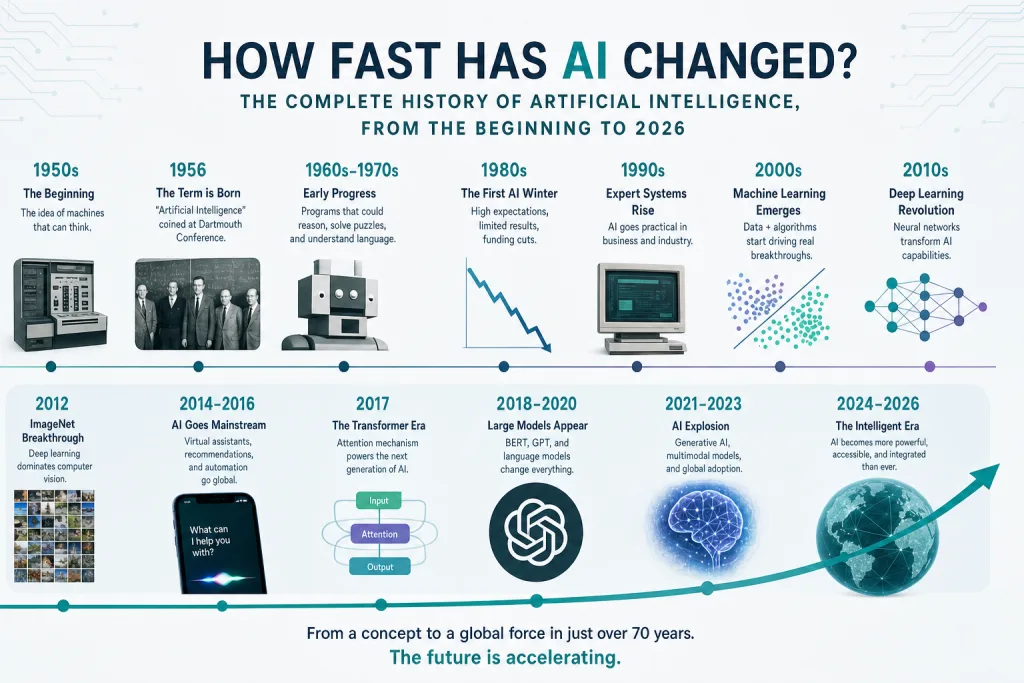
In 1950, Alan Turing asked a deceptively simple question — can machines think? — and proposed the imitation game we now call the Turing Test. Six years later, a summer workshop at Dartmouth College gave the field its name and its founding optimism. The early pioneers believed a thinking machine was maybe twenty years off. They were wrong by about half a century, and that miscalculation defined the field’s first several decades.
The early approach was symbolic AI: the idea that intelligence could be captured in explicit rules, logic, and hand-coded knowledge. If you could just write down enough if-this-then-that statements, the reasoning would follow. This produced some genuinely useful “expert systems” in the 1970s and 80s — programs that could diagnose certain diseases or configure computer orders — but it hit a wall. The real world is too messy, too full of exceptions, to be captured by rules a human types in by hand.
When the promises outran the results, funding dried up. The field endured two long, cold stretches now known as the AI winters, when “AI” became almost a dirty word among serious researchers who did not want their grant applications thrown in the bin.
Quietly, though, a different idea was surviving on the margins: machine learning. Instead of programming intelligence in by hand, what if you let a system learn patterns from data? Neural networks — loosely inspired by the brain — had existed since the 1950s, but they were computationally starved and mostly dismissed. Through the 90s and 2000s, statistical machine learning powered spam filters, recommendation engines, and search rankings. It worked, it made money, and almost nobody outside the field called it “AI.” It was just… software that got better with more data.
The pieces were on the board. They just needed the right moment.
The Spark: How Deep Learning Ignited in 2012
If you want a single date where the modern era begins, a strong candidate is 2012.
That year, a neural network called AlexNet entered the ImageNet competition — an annual contest to correctly label millions of images — and did not just win. It won by a landslide, cutting the error rate so dramatically that the result read like a typo. It used a “deep” neural network (many layers stacked on top of each other) trained on graphics cards, or GPUs, which happened to be brilliant at the exact kind of parallel math that neural networks require.
That combination — big data, deep networks, and cheap parallel compute — was the spark. Suddenly the neural-network approach that had been dismissed for decades was not just viable; it was dominant. Within a few years, deep learning had blown past older techniques in image recognition, speech recognition, and translation. The tech giants noticed. They started hiring every deep-learning researcher they could find and pointing enormous compute budgets at the problem.
For the first time, “throw more data and more compute at a bigger network” was a strategy that reliably worked. That insight would soon reshape the entire industry — but the field still lacked one crucial ingredient to handle language properly.
The Architecture That Changed Everything: Transformers (2017)
Here is the breakthrough almost nobody outside AI has heard of, even though it underpins nearly everything you now use.
In 2017, a team of Google researchers published a paper with a cheeky title: Attention Is All You Need. It introduced the Transformer, a new neural-network architecture built around a mechanism called attention — a way for a model to weigh how much every word in a sentence relates to every other word, all at once, in parallel.
That sounds abstract, so here is why it mattered. Previous language models processed text one word at a time, in sequence, which made them slow to train and forgetful over long passages. Transformers processed everything in parallel and could hold long-range relationships in “mind.” They were faster to train, scaled beautifully with more data and compute, and — critically — they got better in a smooth, predictable way as you made them bigger.
That last property is the quiet engine of the entire boom. Researchers discovered what became known as scaling laws: pour in more parameters, more data, and more compute, and performance improves in a reliable curve. For a field that had spent decades hunting for clever tricks, this was almost too good. You did not need a new idea every year. You needed a bigger version of the same idea. The Transformer turned intelligence into something you could, to a meaningful degree, buy.
Every large language model you have heard of — GPT, Claude, Gemini, Llama, DeepSeek, Qwen, and the rest — is a Transformer, or a close descendant of one. That 2017 paper is the hinge the modern world turns on.
The GPT Era and the Birth of the Modern LLM (2018–2022)
A young lab called OpenAI took the scaling-laws bet more seriously than almost anyone. Their thesis was simple and, at the time, controversial: take a Transformer, train it on a staggering amount of internet text to predict the next word, make it huge, and see what happens.
The results arrived in escalating waves:
- GPT-1 (2018) proved the concept on a modest scale.
- GPT-2 (2019) was good enough at generating coherent paragraphs that OpenAI initially hesitated to release the full model, citing misuse fears — a decision that generated headlines and a fair amount of eye-rolling, but also signalled that something had shifted.
- GPT-3 (2020) was the jaw-dropper. At 175 billion parameters, it could write essays, answer questions, produce working code, and imitate styles — all without being specifically trained for any of those tasks. It learned them as a side effect of learning to predict text. Developers who got early access spoke about it the way people talk about seeing a magic trick they cannot explain.
Something profound was happening here. Nobody programmed GPT-3 to write poetry or debug Python. Those abilities emerged from scale. The model was simply trying to guess the next word, and in getting very good at that, it absorbed a working approximation of grammar, facts, reasoning, and style. This property — capabilities appearing unbidden as models grow — is called emergence, and it is why even the researchers building these systems are routinely surprised by what they can do.
By 2022, powerful language models existed. But they lived behind developer APIs, spoke in a raw and sometimes unhinged way, and were the domain of a few thousand enthusiasts. The general public had no idea. That was about to change overnight.
ChatGPT: The Week AI Went Mainstream
On November 30, 2022, OpenAI released a free research preview of a chatbot built on its GPT-3.5 model. They called it ChatGPT. Internally, expectations were modest.
It became the fastest-growing consumer application in history, reaching a hundred million users in roughly two months.
The technology underneath was not radically new. What was new was the packaging: a simple chat box, a model tuned to follow instructions and hold a conversation, and — crucially — no barrier to entry. Anyone could go to a website and talk to it. Your parents could use it. Your kids could use it. And for millions of people, that first conversation was the moment abstract “AI” became a concrete thing that could write their emails, explain their homework, plan their trips, and draft their code.
The cultural detonation was instant. Schools panicked about essays. Companies scrambled to form “AI strategies.” Investors opened their checkbooks. Every technology executive on the planet suddenly had one item at the top of their agenda. ChatGPT did not just launch a product; it fired the starting gun on the most intense corporate competition the tech industry has seen since the smartphone — arguably since the internet itself.
From here, the timeline stops crawling and starts to blur.
The Closed-Model Arms Race (2023–2026)
Once ChatGPT proved the market, the biggest, best-funded labs in the world went to war. These are the closed models — proprietary systems whose weights are kept private and accessed through apps and paid APIs. They sit at the frontier of raw capability, and the competition between them has been relentless.
2023 set the pattern. OpenAI released GPT-4, a dramatic leap that could reason, pass professional exams, and handle images as well as text. Anthropic — founded by former OpenAI researchers — launched Claude, emphasizing safety, long documents, and a more thoughtful conversational style. Google, caught flat-footed by ChatGPT despite having invented the Transformer, regrouped and shipped Gemini. The three-way race was on.
Then it just… kept escalating. Each lab leapfrogged the others every few months. Context windows — how much text a model can consider at once — exploded from a few thousand words to entire books and codebases. Models gained the ability to see images, hear audio, browse the web, and use tools. Elon Musk’s xAI entered with Grok, wired directly into the social platform X.
Two shifts define the frontier as it stands in 2026, and they matter more than any single model name:
First, the rise of reasoning. A new class of “thinking” models learned to work through problems step by step before answering — pausing to reason internally rather than blurting out the first response. This closed much of the old gap on math, logic, and complex coding, and it turned benchmarks that stumped 2023’s models into routine wins.
Second, the shift from chatbots to workers. The defining theme of 2026 is agentic AI. The leading models no longer just answer questions — they take actions. They operate computers, write and deploy code across many files, run multi-step tasks that stretch over minutes or hours, and plug into business systems to actually get things done. The interface metaphor quietly moved from “assistant you chat with” to “colleague you delegate to.”
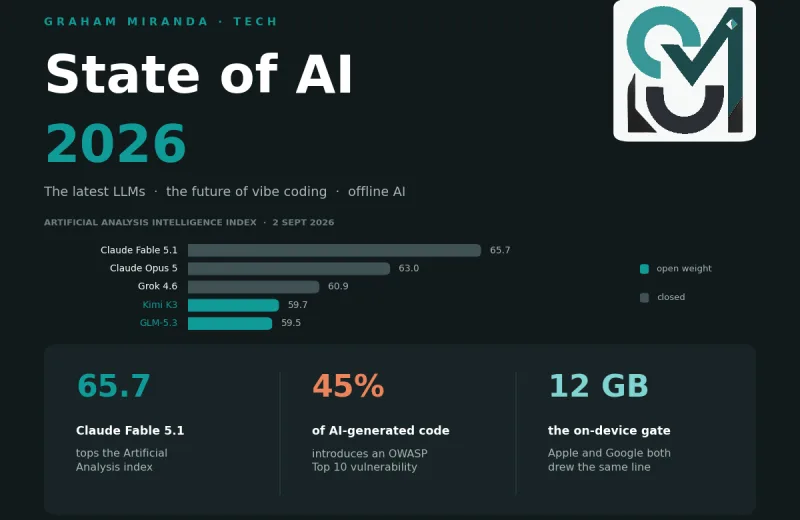
As of mid-2026, the closed frontier is a tight cluster at the top: Anthropic’s Claude Opus 4.8, OpenAI’s GPT-5.5, Google’s Gemini 3.1 Pro, and xAI’s Grok 4.3, with the four labs trading the lead every few weeks. <span>The most striking thing about the current top tier is how close it has become — the gap between “best” and “second best” is now often a rounding error, and it changes hands constantly.</span>
The race also got geopolitical. In mid-2026, one Anthropic frontier model became — as far as anyone can tell — the first ever to be switched off and then back on by regulators, briefly suspended under a U.S. export-control order before access was restored. Frontier AI is no longer just a product category. It is an instrument of national policy.
The Open-Model Revolution: Weights for the People
While the giants battled behind their APIs, a parallel and equally important story was unfolding: the rise of open models.
The turning point came in early 2023, when Meta released LLaMA, a capable language model whose weights leaked and then were formally shared with researchers. For the first time, a genuinely strong model was something you could download, run on your own hardware, inspect, and modify. A global community of developers and hobbyists erupted around it, producing an astonishing wave of fine-tuned variants, optimizations, and tools — often faster than the big labs could ship features.
That community energy never let up, and by 2026 the open ecosystem has matured into a serious rival to the closed frontier. A few things worth understanding:
Open weights is not the same as open source. This distinction trips up a lot of people. Open source means the training code, the data, and the weights all ship under a permissive license. Open weights means you get the model files to download and run, but the license may restrict how you use them, and the training data and full recipe often stay private. Most models people casually call “open source” are actually open-weight. The difference matters enormously for businesses worried about compliance — which is why licensing has become a genuine competitive feature. Permissive Apache 2.0 and MIT licenses (used by families like Qwen, DeepSeek, and others) are prized precisely because they let companies build freely.
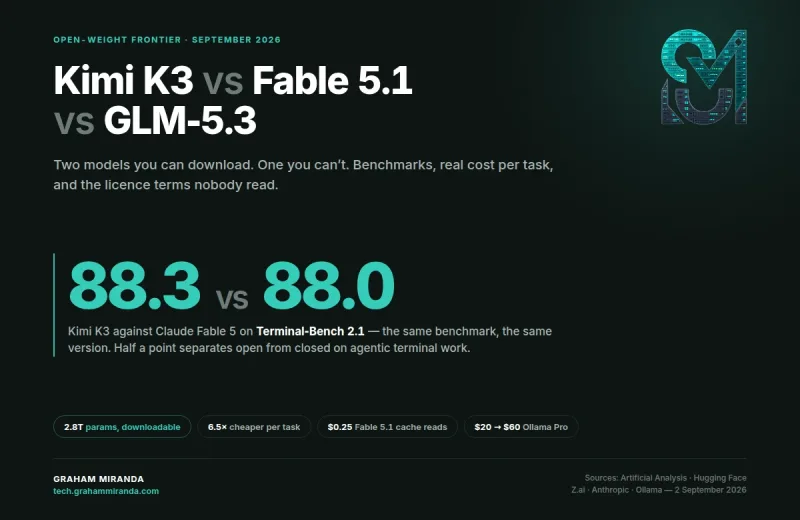
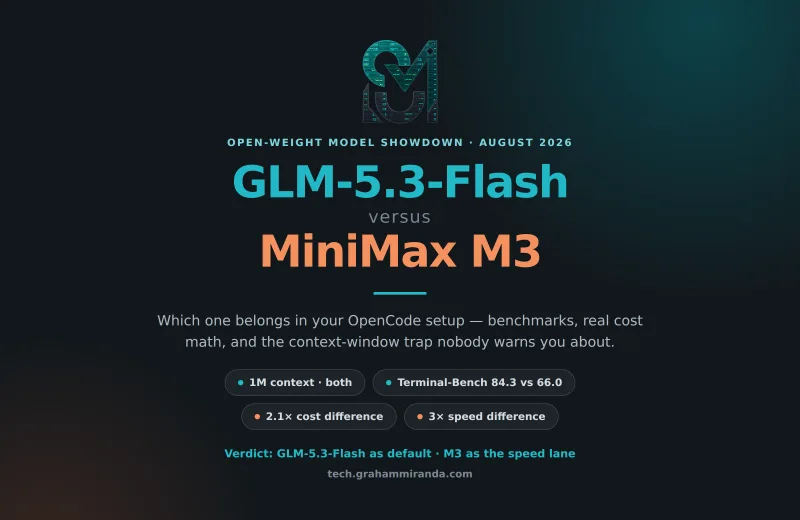
The center of gravity shifted East. Some of the most capable open-weight models of 2026 come from Chinese labs: DeepSeek (celebrated for frontier-class reasoning at shockingly low cost), Alibaba’s Qwen (a sprawling, permissively licensed family running from tiny laptop models to massive systems), Moonshot’s Kimi, and Zhipu/Z.ai’s GLM series. Meta’s Llama 4 anchors the Western open tier, Google’s lightweight Gemma models are built to run on a single GPU or even a laptop, and Europe’s Mistral shifted its flagship models to permissive licensing. The open leaderboard now reshuffles almost monthly — recent snapshots have placed models like GLM-5.2 and Kimi’s latest at or near the very top of independent open rankings, with several open models edging into territory that used to belong exclusively to the closed frontier.
The price collapse. Perhaps the most consequential open-model story is economic. Competition — much of it driven by these open and low-cost providers — has pushed the price of intelligence off a cliff. Capabilities that cost a small fortune in API fees two years ago are now available for cents per million words, or free if you self-host. Analysts now estimate the best open weights trail the best closed models by only months on many benchmarks, not years. For a huge swath of real-world tasks, the open option is now good enough, cheap enough, and private enough to win.
This is the quiet revolution beneath the headlines. The frontier grabs attention, but the commoditization of “good enough” AI — running on your own servers, under your own control, at near-zero marginal cost — may end up reshaping more industries than any single flagship model.
When AI Learned to See and Paint: The Image-Generation Story
Language was only half the revolution. The other half was visual — and it arrived just as fast.
The early machinery for AI images was the GAN (Generative Adversarial Network), introduced in 2014. The clever idea: pit two networks against each other, one generating fake images and one trying to spot the fakes, until the generator gets so good the fakes become convincing. GANs produced eerily realistic faces — the “these people do not exist” era — but they were finicky to train and hard to control with words.
The real consumer breakthrough came from a different technique: diffusion models, which learn to create images by starting with pure noise and gradually refining it into a coherent picture, guided by a text prompt. The results, and the timeline, were staggering:
- DALL·E and DALL·E 2 (2021–2022) from OpenAI showed the world that you could type a whimsical sentence — “an astronaut riding a horse in photorealistic style” — and get a startlingly good image back.
- Midjourney (2022) arrived with a distinctive, gorgeous aesthetic and built a massive community, becoming shorthand for beautiful AI art.
- Stable Diffusion (2022) did for images what LLaMA later did for text: it was released openly. Anyone could run it, fine-tune it, and build on it. An entire open ecosystem of tools, plugins, and custom models exploded overnight.
From there, the field sprinted. The old failure modes — mangled hands, gibberish text, uncanny faces — got solved one by one. By 2026, the image-generation market has split into clear camps, and the quality is high enough that outputs routinely pass casual human inspection:
- Midjourney (now on its V8 line) remains the aesthetic favorite for stylized, scroll-stopping art.
- OpenAI’s GPT Image models (the successors to DALL·E, now built right into ChatGPT) lead on following complex instructions and rendering text inside images correctly — a problem that plagued every model for years.
- Black Forest Labs’ FLUX became the open-weights champion, matching premium closed models on photorealism at a fraction of the cost, and pulling most serious open-source users away from older Stable Diffusion builds.
- Google’s Imagen and “Nano Banana” models and Adobe’s Firefly (trained on licensed data, which enterprises love for legal safety) round out the professional field.
- And, echoing the LLM story, Chinese models like ByteDance’s Seedream surged up the rankings.
The frontier is no longer just about making a pretty picture. It is about editing — conversationally selecting a region and asking for changes — and about consistency, keeping the same character or product identical across dozens of images. AI image generation went from a novelty to a professional production tool in roughly four years.
When AI Learned to Move: The Rise of AI Video
If images were four years ago’s miracle, video is this era’s. And nothing captured the sheer velocity of AI progress quite like watching text-to-video go from a punchline to a threat to the film industry in under three years.
As recently as 2023, “AI video” meant a few seconds of blurry, flickering motion with melting faces and objects that morphed into nonsense between frames. It was a curiosity, not a tool.
Then, in early 2024, OpenAI previewed Sora, and the conversation changed instantly. Its clips were photorealistic, temporally coherent, and cinematic in a way that felt like it had skipped several years of expected progress. Every competitor immediately started chasing that bar.
The chase produced a remarkable field. By 2026, the serious contenders include Google’s Veo, Runway’s Gen-4 line (built into a full creative editing environment rather than sold as a raw model), and a wave of powerful Chinese models — Kling (Kuaishou), Seedance (ByteDance), and others — that now dominate the top of independent video-quality leaderboards. The technical bar moved fast: native synchronized audio — including generated dialogue with correct lip-sync in multiple languages — went from science fiction to a standard feature in about a year.
The plot twist nobody predicted: Sora, the model that started the race, got shut down. OpenAI discontinued the Sora web and app experiences in April 2026, with the API following later in the year. The tool that set the pace was overtaken and retired while the field it inspired thundered ahead — a near-perfect symbol of how brutally fast this space moves. Set the bar, and eighteen months later you may be a legacy benchmark.
Today, a solopreneur with a text prompt and a modest budget can generate footage that would once have required a location, a crew, and a five-figure budget. The technology still has real limits — physics glitches, consistency across long scenes, and serious legal and ethical questions around likeness and disclosure — but the trajectory is unmistakable.
Beyond Text and Pixels: Voice, Multimodality, and the Age of Agents
The neat categories this article uses — text, image, video — are, honestly, already dissolving. The defining direction of the current era is that these capabilities are merging into single, unified systems.
Multimodality is the technical name. The frontier models of 2026 are not text models with an image feature bolted on; they natively see, read, hear, and generate across formats in one continuous flow. You can show one a photo of your fridge and ask for a recipe, share a screenshot of a bug and get a fix, or speak to it and have it speak back in a natural, interruptible voice with almost no lag. The clumsy old loop of “type, wait, read” is giving way to something that feels much more like talking to a capable person.
And then there are agents — the theme that ties the whole 2026 story together. An agent is an AI system that does not just respond but acts: it plans a multi-step task, uses tools and software, checks its own work, and carries the job to completion with minimal hand-holding. Booking travel, reconciling a spreadsheet against three data sources, refactoring a codebase, running a research project across dozens of web pages — these are moving from “demo” to “daily workflow.” The interface is shifting from a chat window to a delegation queue.
This is the through-line of AI’s entire history, arriving at its logical conclusion. We went from programming computers with explicit rules, to training them on data, to conversing with them in plain language, to — now — delegating real work to them. Each step removed a layer of friction between a human intention and a finished result. Agents are the current frontier of that removal.
Why Did AI Suddenly Move So Fast?
Step back from the model names and version numbers, and a natural question emerges: after fifty years of crawling, why did AI suddenly sprint? A handful of forces converged, and it was the convergence — not any single one — that lit the fuse.
Compute got absurdly powerful and abundant. The same GPUs that render video games turned out to be perfect for training neural networks. As chips improved and data centers scaled, the raw horsepower available for AI training grew exponentially. Ideas that were theoretically sound in the 1990s were simply unrunnable until the hardware caught up.
Data became a firehose. The internet spent thirty years accumulating a near-limitless corpus of human text, images, and video. That vast, messy record of human knowledge and expression became the training material. No internet, no modern AI.
The Transformer unlocked scale. As we saw, the 2017 architecture made it possible to reliably convert more compute and more data into more capability. That predictability turned research into something closer to engineering — and engineering problems get solved fast when money shows up.
Money showed up. ChatGPT proved there was a colossal market, and capital flooded in. Tens of billions of dollars poured into labs, chips, and talent. That funding compressed timelines that would otherwise have stretched across decades.
Fierce competition set the tempo. With OpenAI, Google, Anthropic, Meta, xAI, and a dozen Chinese labs all racing, no one could afford to slow down. A lead that took six months to build could evaporate in six weeks. That pressure is exactly why you see a new flagship almost every time you check the news.
Open ecosystems multiplied the effort. Every openly released model turned thousands of independent developers into unpaid R&D. The collective intelligence of the global open-source community accelerated progress in ways no single company could match, and drove the price of AI toward the floor.
Put those together and you get the steepest capability curve technology has ever produced. It is less like a single invention and more like a chain reaction.
Where AI Goes Next
Predicting AI’s future is a great way to look foolish in six months — this article has documented how routinely the experts were surprised. But the current trajectory points at a few things with reasonable confidence.
Agents get real. The next phase is less about models that know more and more about systems that reliably do more — completing long, complex, multi-step work with genuine autonomy. Expect the “AI worker” framing to intensify, along with hard questions about oversight, reliability, and what happens to jobs built on tasks that agents can now handle.
Intelligence keeps getting cheaper. The price collapse is not finished. As open models close the gap and efficiency improves, capable AI trends toward being nearly free and running locally — on your phone, your laptop, your own servers. That commoditization may reshape entire industries more quietly and more thoroughly than any single headline model.
The lines keep dissolving. Text, image, audio, and video are converging into unified systems, and “using an AI” will feel less like visiting a tool and more like a capability woven invisibly into everything you already do.
Governance moves to center stage. The brief regulatory shutdown of a frontier model in 2026 was a preview. As AI becomes critical infrastructure and a lever of geopolitical power, questions of safety, copyright, control, and national strategy will shape the field as much as any research breakthrough. The technical race and the policy race are now the same race.
The one safe prediction is that the pace does not slow. Every chapter of this history was written by people confidently underestimating how fast the next chapter would arrive.
Frequently Asked Questions
When did modern AI actually begin? The concept dates to the 1950s, but the modern deep-learning era is usually traced to 2012, when the AlexNet neural network dominated an image-recognition competition and proved that deep networks plus big data plus GPU compute was a winning combination. The public-facing boom began later, with ChatGPT’s launch in November 2022.
What is the difference between open and closed AI models? Closed models (like GPT-5.5, Claude, and Gemini) keep their weights private and are used through apps or paid APIs. Open models (like Llama, DeepSeek, Qwen, and GLM) share their weights so anyone can download, run, and modify them. A key nuance: “open weights” means you get the model files, while true “open source” also includes the training code and data — most so-called open-source models are actually open-weight.
What was the most important breakthrough in AI history? Many researchers point to the 2017 Transformer architecture, introduced in the paper Attention Is All You Need. It made models scalable and efficient to train, and it underpins virtually every major AI system in use today, from chatbots to image generators.
How did AI image and video generation get so good so fast? Image generation leapt forward with diffusion models around 2021–2022 (DALL·E, Midjourney, Stable Diffusion), then rapidly solved old problems like distorted hands and unreadable text. Video followed a similar curve, going from a few seconds of blurry motion in 2023 to photorealistic, audio-synced clips by 2026, driven by intense competition among models like Veo, Runway, Kling, and Seedance.
Is AI progress going to slow down? There is no sign of it yet. The combination of abundant compute, massive investment, fierce competition among labs, and a thriving open-source community keeps pushing the pace. If the history above teaches anything, it is that the next wave has consistently arrived faster than anyone expected.